Northwest Lagotto Announces
A Breeding of Note
NBISS · GCHS · CHICIl Granaio dei Malatesta Flocky × Gillenias · SwedenGillenias Elizabeth
Autumn 2026 · Lynden, Washington
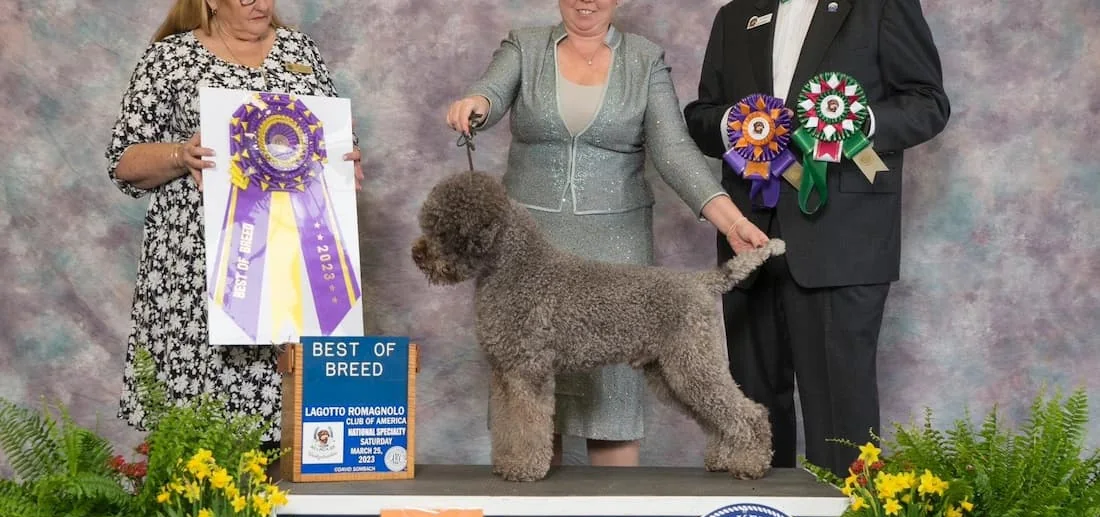
We breed once in a season, at most, and every litter exists to answer a question. This one answers the largest question a small program can ask: what happens when the #1 Lagotto Romagnolo in the United States meets a dam whose pedigree was assembled an ocean away from his, and crosses it exactly once.
The Sire
Il Granaio dei Malatesta Flocky
Flocky was bred by Monica Benelli and Marco Damiani at Il Granaio dei Malatesta in Bastia Umbra, Italy, the kennel our own foundation came from. Monica owns him; Traci Chan and Blair Aguillard showed him in the United States. His record is short to state:

Three different judging panels, under three different sets of conditions, reached the same conclusion in the same year. Agreement at that level comes from the dog.
Frozen semen from this dog is not commercially available. This breeding exists because Monica Benelli authorised it.
That sentence is the whole of our case for exclusivity, and we will not decorate it. The breeder who produced Flocky, and who produced our foundation dam before him, reviewed this pairing and said yes. Everything else on this page is documentation.
The Dam
Gillenias Elisabeth
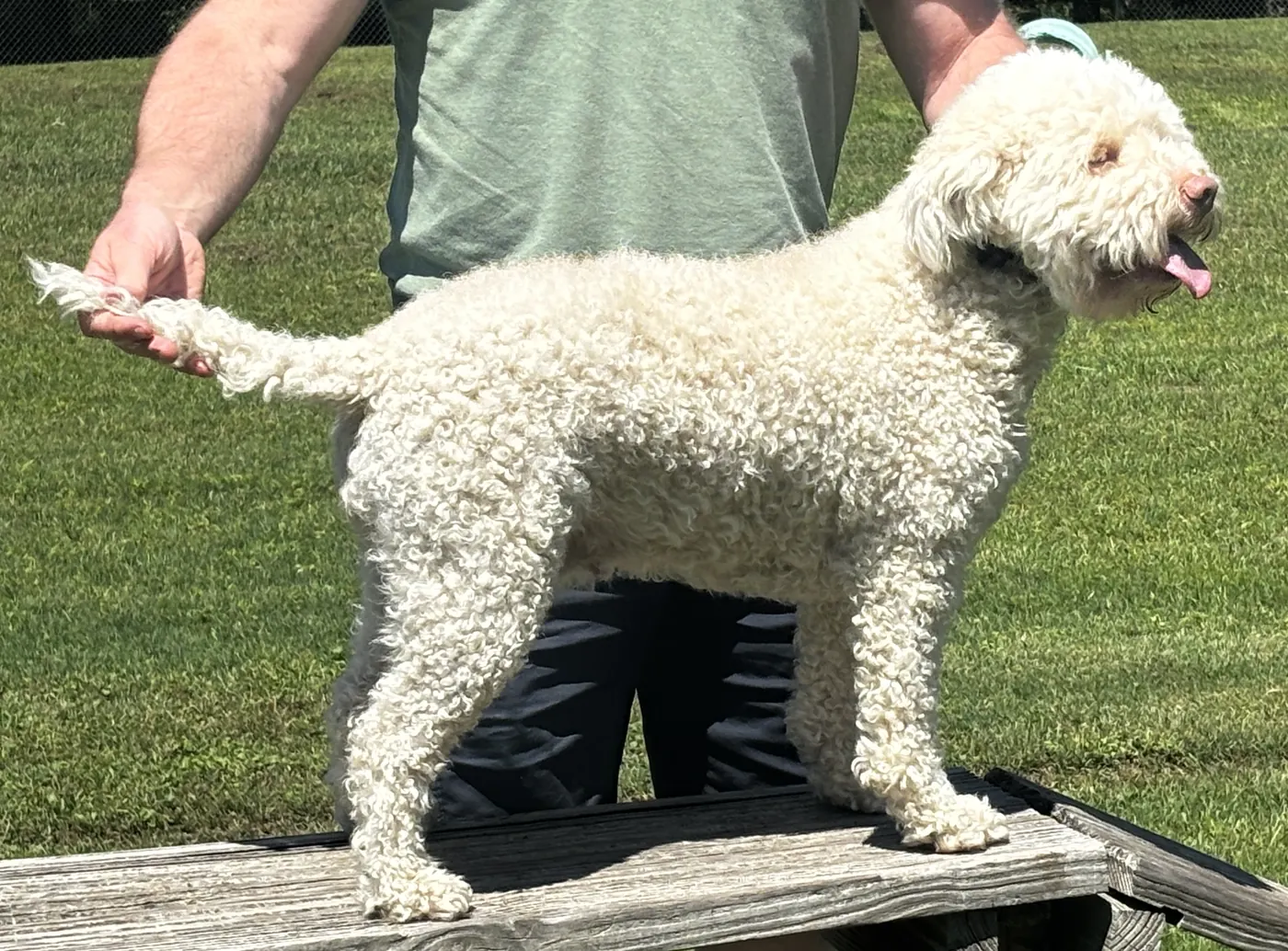
Blanca is the deliberate half of this pairing. Bred by Anna Peterson at the Gillenias kennel in Sweden, she carries a pedigree assembled in parallel to the Italian mainstream rather than derived from it, Scandinavian selection over decades, reaching back through the Dutch Rozebottel line of Katrien van Gemert, the first breeder ever to win Crufts with a Lagotto. Her documented pedigree coefficient of inbreeding stands at 0.65 percent, a figure most working pedigrees in this breed cannot approach.
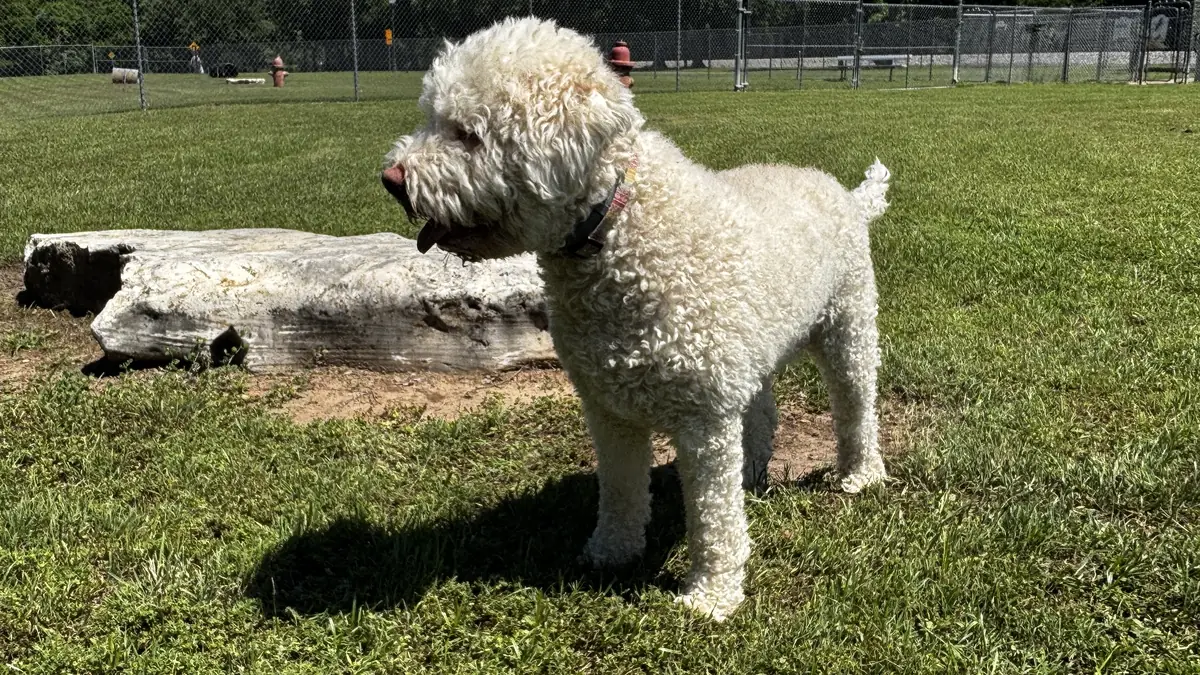
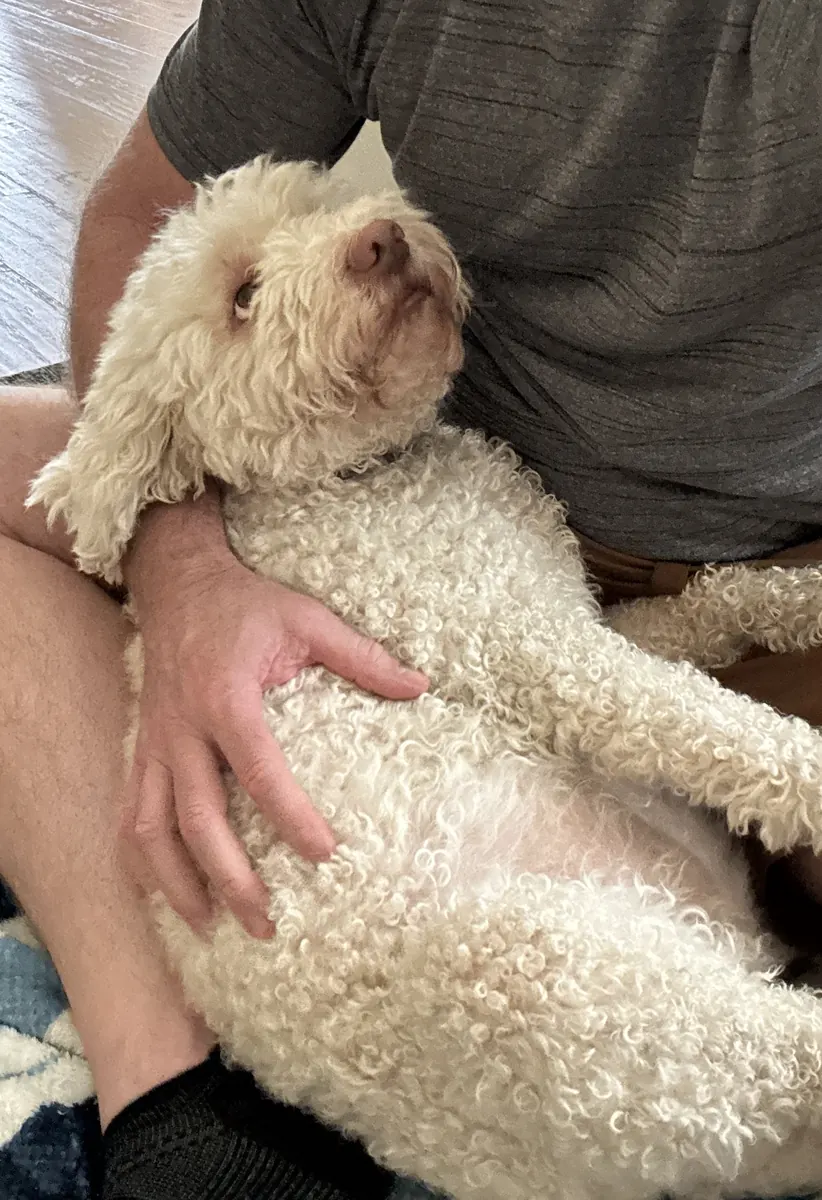
She is five years old, in full health, and entirely typical of what careful Scandinavian breeding produces: calm, curious, deeply bonded, unreactive. In our years with her we have not seen anxiety, sharpness, or instability. Structure can be photographed; temperament has to be lived with. We live with hers, and it is the temperament we want in every puppy that carries our name.
Documented Health
Both Parents, In Full
We publish complete panels, including the results a sales page would omit. Breeders read health honestly or not at all.
Flocky
NBISS GCHS · CHIC certified
Blanca
Gillenias Elizabeth · health tested
One line in those tables deserves a sentence. Flocky carries a single copy of crd4/cord1; Blanca is genetically clear. Paired this way, no puppy in this litter can be affected by PRA. Some may inherit one carrier copy, which has no health consequence for the dog itself and is simply managed in any future pairing, exactly as it was managed in this one. This is what carrier status is for: a program that tests fully can use an outstanding dog without ever producing the disease.
The Pedigree
Three Generations, Typeset
Read it the way a breeder reads it, left to right, parents to great-grandparents. The two halves of this chart were assembled in different countries by different hands, and they meet in exactly one place.
Highlighted: the single thread the two pedigrees share. Zeus (Foianesi) stands as Flocky’s maternal grandsire; Blanca reaches him one generation further back, through his son Spino della Cascinetta. Pedigree data: The Breed Archive and registry records.
The Rationale
Why These Two
Most pairings available in North America fold the same handful of American lines back on themselves. This one does the opposite. Flocky is the direct expression of the Italian mainstream at its absolute best, the kennel that has defined modern breed type, judged so at Westminster and at the breed’s own National Specialty. Blanca is what Scandinavian selection built in parallel over the same decades: a different route back to the same Italian foundations, carrying the Rozebottel and Lingotto D’oro lines that barely exist on this continent.
The chart above is the argument. Three generations deep, the two pedigrees intersect at a single dog, a thread of linebreeding back to Zeus (Foianesi) and the della Cascinetta dogs, inside what is otherwise a genuine outcross. That structure is not an accident; it is the reason this pairing was made. It concentrates what the Italian line does best while opening the gene pool that American breeding has spent a decade narrowing. Pedigree COI and genetic COI are different measurements, we say so plainly, but both halves of this pairing were chosen with the same intent: puppies with depth behind them and room in front of them.
We are selecting for what we always select for, in order: temperament, structure, health, coat. The puppies will carry two pedigrees assembled over decades, on two separate paths, by breeders at the top of theirs. What they do with them, in a breeding program, in the ring, or asleep on a kitchen floor in Whatcom County, is the next chapter.
Placements
Where These Puppies Are Going
This litter is positioned first for breeding programs, established kennels, and serious people at the beginning of one, who understand what this particular combination of pedigrees offers and intend to build on it. Placements of that kind are conversations, not transactions, and we expect them to begin well before the litter is on the ground.
A small number of companion placements will be made alongside them, to households, ideally near us in Washington, who want a dog of this quality and are prepared to work closely with us over the years that follow. If that describes you, you do not need to know what that partnership looks like before writing; that is what the first conversation is for.
Every puppy, in every placement, is raised identically: whelped in our home, on the Puppy Culture protocol, early neurological stimulation, structured enrichment, deliberate socialization through the developmental windows, with the same health testing, the same documentation, and the same matching process we describe across this site. A litter of this calibre does not change the program. It is what the program was built for.
Inquiries are open, write Mark & Tracy
The Season
Timeline
Questions
Asked Already
When will the litter be born, and when do puppies go home?
The breeding is planned for July 2026 on Blanca’s cycle, with whelping expected in September 2026. Puppies go home at eight weeks, in November 2026, to their matched families.
Who are the parents?
The sire is NBISS GCHS Il Granaio dei Malatesta Flocky CHIC, Best of Breed at the 147th Westminster, Best in Specialty Show at the 2023 LRCA National Specialty, and the #1 Lagotto Romagnolo in the United States in 2023. The dam is Gillenias Elizabeth (Blanca), a Swedish-import dam bred by Anna Peterson, with full health clearances and a documented pedigree COI of 0.65 percent.
How are puppies being placed?
First to breeding programs, established kennels and serious people at the beginning of one. A small number of companion placements will be made to households prepared to work closely with us over the years that follow. Every inquiry goes to Mark and Tracy.
The sire is a PRA carrier, what does that mean for the puppies?
Nothing, for their health. Flocky carries one copy of crd4/cord1 and Blanca is genetically clear, so no puppy in this litter can be affected by PRA. Some puppies may be carriers, which has no effect on the dog itself and is simply noted for any future breeding decision.
I am already on a Northwest Lagotto waitlist. Can I move to this litter?
Yes. Write Mark and Tracy and ask to roll your place to this litter; we will confirm where things stand.
Inquiries
Mark and Tracy handle all correspondence for this litter. Tell us who you are, what you are building or looking for, and where you are. The rest is a conversation.
Write Mark & Tracy, Mark & Tracy Nelson · Northwest Lagotto LLC · Lynden, Washington
More from Northwest Lagotto
Common Questions
Questions families ask
When will the Blanca × Flocky litter be born, and when do puppies go home?
The breeding is planned for July 2026 on Blanca’s cycle, with whelping expected in September 2026. Puppies go home at eight weeks, in November 2026, to their matched families.
Who are the parents of this Lagotto Romagnolo litter?
The sire is NBISS GCHS Il Granaio dei Malatesta Flocky CHIC - Best of Breed at the 147th Westminster Kennel Club Dog Show, Best in Specialty Show at the 2023 LRCA National Specialty, and the #1 Lagotto Romagnolo in the United States in 2023. The dam is Gillenias Elizabeth (Blanca), a Swedish-import dam bred by Anna Peterson with full health clearances and a documented pedigree COI of 0.65 percent.
How are puppies from this litter being placed?
The litter is positioned first for breeding programs - established kennels and serious people at the beginning of one. A small number of companion placements will be made to households prepared to work closely with Northwest Lagotto over the years that follow. All inquiries go to Mark and Tracy at [email protected].
The sire is a PRA carrier - what does that mean for the puppies?
Nothing, for their health. Flocky carries one copy of crd4/cord1 and Blanca is genetically clear, so no puppy in this litter can be affected by PRA. Some puppies may be carriers, which has no effect on the dog itself and is noted for any future breeding decision.
Can I join this waitlist if I am already on a Northwest Lagotto waitlist?
Yes. Families on a prior Northwest Lagotto waitlist who would like to be considered for the Blanca × Flocky litter should write to Mark and Tracy at [email protected] and ask to roll their place to this litter.