The Lagotto Romagnolo is often described as one of the oldest breeds in existence, a truffle hunter refined over centuries in the Romagna region of northern Italy.
But the modern breed is not continuous. It is reconstructed.
What exists today descends from a small number of dogs preserved during a near-extinction (see our breed heritage page for the full story) event in the 1970s and 1980s. The recovery was successful. But like all population bottlenecks, it came with a measurable cost, one that shapes every breeding decision made today, and every dog that will be born over the next thirty years.
This essay is not a celebration of the breed. It is a frank examination of where the breed stands genetically, what the science shows, and what it means to breed responsibly when that history is part of every pedigree you work with.
Understanding this is not optional for serious Lagotto breeders. It is the foundation of every decision that matters.
A Breed Rebuilt From the Edge
By the mid-20th century, the Lagotto had nearly disappeared. The draining of the Po Delta marshlands, the ecosystem the breed had been developed to work for centuries of waterfowl hunting, removed the breed's primary purpose almost overnight. Without a working role, the dogs were not maintained, and the population collapsed.
The recovery effort of the 1970s through 1990s was deliberate and ultimately successful. A group of Italian breeders, working under the auspices of the Italian Kennel Club, identified and preserved the remaining dogs and began a formal reconstruction program. The breed was officially recognized by the FCI in 1995.
But the recovery involved a small founding population. How small is debated, but the genetic evidence is not ambiguous: the modern Lagotto carries the signature of a founder bottleneck throughout its genome. This is not speculation about historical events. It is directly readable in the DNA of dogs living today.
The breed was saved. But the cost of that rescue is carried, invisibly, in every chromosome of every living Lagotto.
— The genetic legacy of the 1970s recovery
Emilia-Romagna. The land that shaped the breed, and nearly lost it.
What Genomic Science Actually Measures
Traditional pedigree analysis calculates a Coefficient of Inbreeding (COI) by tracing how often the same ancestors appear on both sides of a family tree. It is a useful tool, but it has a fundamental limitation: it can only measure what the pedigree records.
Modern genomic analysis goes further. By examining the actual DNA sequence directly, scientists can measure Runs of Homozygosity (ROH), long stretches of the genome where both copies of a chromosome are identical. These form when a dog inherits the same DNA segment from both parents because those parents share a common ancestor.
Interpreting ROH Length: What the Segments Tell Us
The critical insight is that pedigree COI systematically underestimates true inbreeding. Pedigrees only capture what has been recorded, and only as deep as the records go. Genomic tools read the actual physical result of those generations of breeding decisions. A dog can have a low pedigree COI and still carry substantial genomic homozygosity from common ancestors too distant to appear in the tracked records.
This matters practically. The genomic inbreeding coefficient (FROH), calculated by dividing the total length of ROH segments by the total genome length, is now considered the most accurate measure of true inbreeding available. For the Lagotto, this number is higher than pedigree COI alone would suggest.
The Numbers: Lagotto Genomic Inbreeding Data
Genomic studies of Italian dog breeds, including the Lagotto Romagnolo, provide the first concrete data on the breed's actual genetic architecture. The findings confirm what the historical narrative predicts, and add specificity to the concern.
Primary Data Source
The SNP-array genomic characterisation study published in Animals (MDPI, 2020, DOI: 10.3390/ani10112013) is a genomic characterization of the Istrian Shorthaired Hound that included the Lagotto Romagnolo among its reference breeds, analyzing dogs on a 220K SNP array; its comparative dataset is one of the few published sources of Lagotto ROH data. A complementary population structure analysis (Talenti et al., 2018, Ecology and Evolution) placed the Lagotto in the broader context of Italian breed genomics.
| Metric | Lagotto Romagnolo | Bracco Italiano | Segugio (avg.) |
|---|---|---|---|
| Mean ROH count (per dog) | ~167 | ~210 | ~150 |
| Mean ROH length (Mb) | 2.70 | 2.81 | ~1.7–2.0 |
| Total genome in ROH (Mb) | ~450.8 | ~592.6 | ~255–313 |
| Pedigree-based COI (breed avg.) | ~2.27% (Sabbioni 2008) | ~6.29% | Variable |
| Interpretation | Moderate–high genomic inbreeding; bottleneck + concentration signal | High genomic inbreeding; popular sire effects evident | Lower historical inbreeding; more diverse founding |
Source: MDPI Animals 10(11):2013, 2020; Talenti et al., Ecology and Evolution, 2018; Sabbioni et al., 2008 (pedigree COI)
Two things are immediately apparent from this data. First, the Lagotto's total ROH coverage, nearly 451 megabases, is substantially higher than the Segugio breeds and reflects the breed's more constrained founding. Second, the Lagotto's pedigree COI of 2.27% gives a misleadingly reassuring picture: it appears low compared to Bracco Italiano (6.29%), but the genomic data tells a more complicated story, since ROH accumulation from the bottleneck is not captured in pedigrees.
What This Means in Practice
Nearly 451 megabases of the Lagotto genome, roughly 17% of the total, exists in homozygous runs. This is the measurable footprint of the 1970s bottleneck. It cannot be eliminated by any individual breeding decision, but it can be prevented from growing further through deliberate outcrossing strategies.
Heterozygosity, The Other Side of the Equation
Genetic diversity is also measured through heterozygosity, the proportion of gene positions where a dog carries two different alleles (one from each parent). Higher heterozygosity means more genetic variation, more adaptability, and generally greater resilience to disease.
Available breed data places Lagotto heterozygosity in the range of approximately 32–38%. This is considered moderate, not catastrophically low, but not robustly diverse either. The breed exists in a zone where it is neither broken nor safe, where the trajectory is determined by the choices made in breeding programs today and over the coming decade.
Genetic Disease in the Lagotto: The Honest Account
The Lagotto is generally regarded as a healthy breed, and by many measures it is. But "healthy" is relative, and the breed carries several inherited conditions that every prospective owner and every serious breeder should understand clearly.
BFJE Carrier Rate, Worldwide Breed Data
Data from thousands of tested Lagotto worldwide: 3% affected, 46% carriers, 51% clear. Nearly half the breed carries this mutation. This is not a fringe problem. It is embedded throughout the global population.
Benign Familial Juvenile Epilepsy (BFJE)
What it is: An autosomal recessive neurological condition causing seizures and ataxia in puppies between 5 and 9 weeks of age, typically resolving spontaneously by 4 months. In the most severe cases, the condition does not fully remit and dogs may show persistent neurological signs. The causative mutation has been identified in the LGI2 gene.
Why the carrier rate matters: At 46% carrier prevalence, any unplanned pairing has a meaningful probability of producing a carrier-to-carrier cross. In such a pairing, 25% of offspring will be affected. Given that seizures in very young puppies can be difficult to distinguish from normal developmental tremors, affected puppies may not always be identified. DNA testing before breeding is not optional, it is essential.
Clear × Clear
100% Clear Offspring
No risk of affected puppies. All offspring will be genetically clear.
Clear × Carrier
50% Carriers, 0% Affected
Preserves genetic diversity. No affected puppies. Requires follow-on testing of retained offspring.
Carrier × Carrier
25% Affected, 50% Carriers
Not recommended. Produces affected puppies. Should not occur in a responsibly managed program.
Lagotto Storage Disease (LSD)
What it is: A progressive neurological disorder caused by a mutation in the ATG4D gene, producing a lysosomal storage disease characterised by cerebellar ataxia, behavioral changes, and neurodegeneration. Unlike BFJE, LSD does not resolve. It progresses, and affected dogs are typically euthanised as the condition advances. Age of onset ranges from 4 months to 4 years.
The scale of the problem: LSD has an estimated frequency of approximately 10% in the breed, making it the most prevalent by carrier rate of the breed's documented genetic conditions. A DNA test is available, and all breeding stock should be tested. As with BFJE, the strategy of carrier × clear pairings allows retention of valuable lines without producing affected offspring.
Cerebellar Abiotrophy (CA)
A degenerative condition causing progressive ataxia through loss of cerebellar cortical cells. Two forms have been identified in the Lagotto, juvenile onset and adult onset, and researchers at the Universities of Helsinki and Bern are investigating whether these represent a single genetic condition or separate diseases. A definitive DNA test is not yet available. Affected dogs are identified clinically; breeding relatives of confirmed cases should be approached with additional caution.
| Condition | Mode of Inheritance | Breed Prevalence | DNA Test Available | Prognosis |
|---|---|---|---|---|
| BFJE (Juvenile Epilepsy) | Autosomal recessive | 3% affected · 46% carriers | Yes, LGI2 mutation | Usually resolves by 4 months; severe cases may persist |
| LSD (Storage Disease) | Autosomal recessive | ~10% frequency | Yes, ATG4D mutation | Progressive; no recovery; euthanasia in severe cases |
| Cerebellar Abiotrophy | Suspected autosomal recessive | Under investigation | Not yet available | Progressive; managed clinically |
Sources: Lagotto Romagnolo Foundation; Paw Print Genetics; University of Bern / University of Helsinki research; Kennel Club breed health data
These conditions illustrate a fundamental principle of population genetics: recessive disease mutations accumulate in bottlenecked populations and become more likely to express as diversity decreases. The Lagotto is not uniquely troubled compared to other reconstructed breeds. But the existence of a 46% BFJE carrier rate in the global population is a direct consequence of the founding bottleneck, and a standing reminder of why genetic testing and diversity management are not separable concerns.
The Core Conflict Every Breeder Faces
Every serious breeder working with a constrained gene pool faces the same tension. There is no clean solution. There is only a hierarchy of considerations, carefully applied.
Option A
Eliminate All Carriers
Remove every carrier of BFJE, LSD, and other known mutations from the breeding population entirely.
→ Eliminates risk immediately in those lines
→ But at 46% BFJE carrier prevalence, this removes nearly half the breed's genetic material
Result: reduced disease risk now, accelerated genetic narrowing long-term
Option B, Current Consensus
Manage Risk, Preserve Diversity
Breed carriers responsibly, always paired with tested-clear dogs, retaining valuable bloodlines while preventing affected offspring.
→ Maintains genetic breadth
→ Requires rigorous testing and transparent record-keeping
Result: no affected puppies, preserved diversity, gradual frequency reduction over generations
The modern veterinary genetics consensus has moved firmly toward Option B. Eliminating carriers wholesale treats the gene pool as if only the next litter matters, when what actually matters is the breed's resilience over the next fifty years. A narrower gene pool is more vulnerable, not less, even if individual disease mutations are temporarily reduced.
The Popular Sire Effect
One of the most significant and least-discussed threats to Lagotto genetic diversity is not dramatic inbreeding. It is invisible concentration through the repeated use of popular sires.
When a male of exceptional quality becomes widely used across global breeding programs, his genetics, including any recessive mutations he carries, are distributed throughout the population within two to three generations. The effect compounds silently. Dogs with no obvious pedigree relationship may share substantial genomic ancestry through a common popular sire several generations back, creating the illusion of diversity while reducing it.
In a breed already operating with a constrained gene pool, limiting any individual male's contribution to the population is not merely good practice. It is a conservation imperative.
What Responsible Breeding Looks Like Now
Based on the current state of population genetics research, the following principles represent best practice for any breeder working with the Lagotto:
- Test every breeding dog before every breeding. BFJE and LSD tests should be considered mandatory, not optional. A breeder who cannot show current clear or managed-carrier status for both parents of a litter is working without information they have no excuse for lacking.
- Prioritise genetic complementarity over similarity. The goal of a pairing is not to produce a dog that looks like its parents. It is to produce a dog with the widest possible healthy genome. Genomic diversity is an asset. Treat it as one.
- Use genomic tools, not just pedigrees. Pedigree COI is a proxy. It underestimates true inbreeding. Where SNP panel testing is available for breeding candidates, use it. The information it provides is measurably more accurate.
- Limit use of popular sires. Regardless of how exceptional a male is, constraining his total contribution to the gene pool, both personally and through the breeding decisions of others who use him, is a genuine service to the breed.
- Think in generations, not litters. The consequences of today's breeding decisions will not be fully visible for a decade. The question is not "is this litter healthy?" but "will the breed still be robust thirty years from now?"
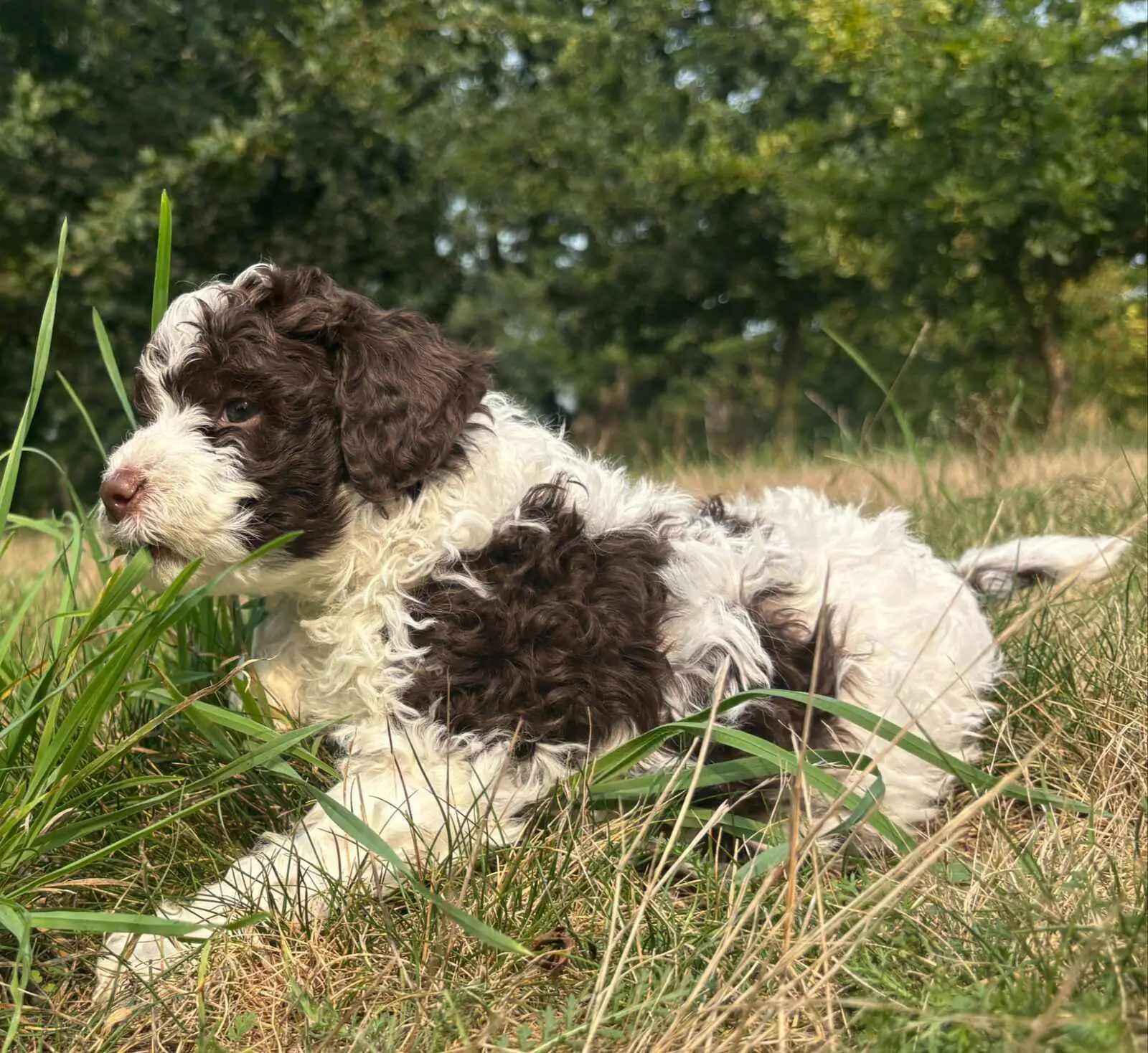
The goal is not uniformity. The goal is resilience.
Our Approach at Northwest Lagotto
We have been explicit about this since we began our program: we are not optimising for uniformity. We are optimising for resilience over time.
That means several things in practice. We prefer outcrossing over linebreeding. We test every breeding dog for BFJE and LSD before any pairing, and we do not breed carrier-to-carrier. We conduct careful pedigree analysis beyond surface-level COI, looking at the depth of shared ancestry that pedigree numbers alone do not capture. We actively consider the genomic consequences of our sire selections for the breed population, not just for our own kennel.
We import from Italy not only because Italian bloodlines represent the deepest expression of the breed, which they do, but because introducing lines with genuinely different founding populations is one of the few tools available to any breeder working to meaningfully extend genetic breadth beyond what North American pedigrees alone can provide. The story of our three-generation lineage, from Mocha's Italian career to the dogs we breed today, is a practical illustration of how these genetic principles translate into real decisions.
Health is not just the absence of disease. It is the presence of diversity, the resilience to face whatever challenges the next generation brings.
— Northwest Lagotto breeding philosophyThe Lagotto Romagnolo exists today because a generation of Italian breeders cared enough to save it. What happens over the next thirty years depends on whether the breeders working now understand that the work of preservation is not finished. It is ongoing, and it is expressed in every breeding decision made.
The dogs we place with families are not the end of that story. They are a chapter of it.
The Northwest Lagotto Standard
We import champion bloodlines from Italy and the United States. We OFA-certify every breeding dog. We test for every heritable condition the breed is known to carry. We do not breed for convenience or volume. We breed when we have the right pairing, and we place our puppies in homes that will hold that standard for the life of the dog.
If you want to understand exactly how we approach genetic selection, which sires we use, which tests we run, what our specific breeding pairs look like. We are available to discuss it. We believe transparency is not just good ethics. It is how trust is built between breeders and the families who entrust their lives to these dogs.
References & Citations
- Preloga V, Šalamon D, Dürkin I, et al. (2020). Genomic Characterization of the Istrian Shorthaired Hound. Animals 10(11):2013. DOI: 10.3390/ani10112013, includes ROH data for Lagotto Romagnolo as a reference breed
- Talenti A, Dreger DL, Frattini S, et al. (2018). Studies of modern Italian dog populations reveal multiple patterns for domestic breed evolution. Ecology and Evolution 8(5):2911–2925. DOI: 10.1002/ece3.3842
- Sabbioni A, Beretti V, Vaccari Simonini F. (2008). Parametri demografici, variabilità genetica e struttura della popolazione nella razza canina Lagotto Romagnolo. Proc. 62nd Natl. Congr. SISVet. [Pedigree-based COI 2.27%]
- Seppälä EH, Jokinen TS, Fukata M, et al. (2011). LGI2 truncation causes a remitting focal epilepsy in dogs. PLOS Genetics 7(7):e1002194. DOI: 10.1371/journal.pgen.1002194
- Jokinen TS, Metsähonkala L, Bergamasco L, et al. (2007). Benign familial juvenile epilepsy in Lagotto Romagnolo dogs. Journal of Veterinary Internal Medicine 21(3):464–471. PMID: 17552452
- Lagotto Romagnolo Foundation. BFJE breed-wide testing data. lagottofoundation.org, 3% affected, 46% carriers, 51% normal (thousands of dogs tested)
- Lagotto Romagnolo Foundation. LSD (Storage Disease) data. lagottofoundation.org, ~10% frequency in breed
- Kyriazis CC, Robinson JA & Lohmueller KE (2025). Long runs of homozygosity are reliable genomic markers of inbreeding depression. ScienceDirect. doi.org/10.1016
- Marsden CD, Ortega-Del Vecchyo D, O'Brien DP, et al. (2016). Bottlenecks and selective sweeps during domestication have increased deleterious genetic variation in dogs. PNAS 113(1):152–157. DOI: 10.1073/pnas.1512501113
Questions About Your Future Puppy’s Genetics?
Every pairing we make is evaluated for genetic diversity, health clearances, and temperament. If you’d like to understand exactly how we approach genetics in our program, Mark is happy to walk you through it personally.
Ask Mark Directly →Common Questions
What families ask about genetics and diversity
Is the Lagotto Romagnolo a genetically diverse breed?
The Lagotto Romagnolo carries moderate genomic inbreeding as a direct consequence of the breed’s near-extinction in the 1970s. The modern breed descends from a small founding population, creating measurable runs of homozygosity across the genome. Pedigree-based COI averages around 2.27%, but genomic tools reveal higher effective inbreeding than pedigrees alone can show. The breed is not critically compromised, but exists in a zone where individual breeding decisions still meaningfully shape population health.
What genetic diseases does the Lagotto Romagnolo carry?
The breed has three documented inherited conditions. Benign Familial Juvenile Epilepsy (BFJE): worldwide breed testing shows 3% affected and 46% carriers - nearly half the breed carries the mutation. Lagotto Storage Disease (LSD): a progressive neurological disorder with approximately 10% frequency in the breed. Cerebellar Abiotrophy: a degenerative condition; research for a definitive DNA test is ongoing. All responsible breeders should test for BFJE and LSD before any breeding.
What is the coefficient of inbreeding for the Lagotto Romagnolo?
Pedigree-based analysis places the breed average COI at approximately 2.27%, which appears low. However, pedigree COI systematically underestimates true inbreeding because it cannot account for hidden relatedness beyond the recorded pedigree depth. Genomic tools measuring runs of homozygosity (ROH) reveal substantially higher effective inbreeding, reflecting the 1970s founder bottleneck. Individual dogs’ genomic COI should be measured directly via SNP panel testing.
What is the popular sire effect and why does it matter for Lagotto breeders?
The popular sire effect occurs when a small number of highly desirable males are used extensively across a breed population. Over successive generations, this concentrates both valuable traits and hidden recessive mutations throughout the gene pool, reducing effective population size and increasing relatedness across the breed - even when individual pedigrees appear unrelated. In a breed already carrying post-bottleneck genetic constraints, limiting use of any single sire is a meaningful conservation measure.