That moment when he settles into the sit and looks up. That is not a trick. That is a four-week-old dog discovering that he has a say in what happens next. It is, in the truest sense of the word, communication.
I want to tell you what you are actually watching in that video, because it is more significant than it might first appear. And I want to explain why teaching this one thing, before almost anything else, changes the entire trajectory of your relationship with your dog.

A four-week-old Northwest Lagotto puppy in his second manding session. Four feet on the floor, weight back, eyes up. This is the moment communication begins.
First, What Is Manding?
Etymology
The word comes from B.F. Skinner, the behavioral psychologist who coined "mand" in 1957 to describe a verbal act initiated by the speaker to get something they want. The key word is initiated. A mand is not a response to a command. It originates with the animal.
When we teach a puppy to mand, we are teaching them that sitting and making eye contact is how they ask for things, attention, to be picked up, a treat, for a door to open, for a game to begin. Instead of jumping, pawing, barking, or bulldozing, they sit. They look up. They wait. And when it works, they do it again. And again.
What you are watching in that video is a four-week-old puppy, in only his second session, beginning to understand that he has a language, and that we speak it.
This is not a trick. This is a four-week-old dog learning that he has a voice. Everything that follows in your relationship with this dog starts here.
Why Jumping Up Exists, and Why It's So Hard to Fix Later
Before I explain how manding works, it helps to understand what it replaces.
Puppies jump up because it works. When they were very small and you were very tall, jumping was the only way to get close enough to your face to greet you properly, which is what dogs do with each other. You bent down, or you picked them up, or you laughed and fussed over them. The jumping was rewarded. The lesson was learned.
The problem is not the puppy. The problem is that the behavior was installed early, rewarded repeatedly, and by the time it becomes a nuisance the dog is eight months old, weighs thirty pounds, and has a deeply ingrained habit that makes perfect sense to them. Researchers tracking owner-reported behavior problems consistently find jumping among the top concerns, and consistently find that it is most difficult to address in adolescent and adult dogs precisely because it was allowed, and often encouraged, in puppyhood.
The conventional fixes tend to fail. Pushing the dog away, kneeing them in the chest, saying "off", all of these require the dog to be already jumping before the correction lands. You are always one step behind. And from the dog's perspective, many of these reactions are still a form of attention. You looked at them. You touched them. You spoke to them. You might as well have petted them.
There is also a deeper problem with punishment-based approaches to jumping: jumping is a pro-social behavior. It comes from enthusiasm, from wanting closeness, from warmth toward people. A dog corrected harshly enough for jumping can begin to associate that discomfort with the act of greeting, and that is a road you do not want to go down.
Manding solves this by going before the problem. A puppy taught from four weeks that sitting produces what they want, and that jumping produces nothing, never develops the jumping habit in the first place. It is not suppression. It is replacement, and it happens before the competing behavior has any chance to root.
The Science That Makes This More Than Just Training
Here is where it gets genuinely interesting.
There is a specific detail in how manding is taught that I want to draw your attention to. When I mark and reward a puppy for manding, I am rewarding the sit and the eye contact, the puppy looking up at me. That upward gaze is not incidental. It is the point.
The Research, Nagasawa et al., 2015
The Oxytocin-Gaze Positive Loop
A study published in the journal Science in 2015 (Nagasawa, Mitsui, En, et al., Azabu University, Japan) confirmed something that dog people had intuited for a long time: when a dog and a human make eye contact, both experience a measurable increase in oxytocin, the bonding hormone associated with trust, attachment, and the feelings we typically describe as love.
The same hormonal loop that connects a mother to her infant. Duke University's MacLean and Hare, commenting on the paper, described it as dogs having "hijacked the human bonding pathway" during domestication.
Here is the crucial detail for our purposes: the effect is strongest when the dog initiates the eye contact. Dogs and owners who exchanged long mutual gazes showed the oxytocin increase. Shorter or prompted gazes did not produce the same response. The research is specifically about voluntary, dog-initiated looking, which is exactly what manding produces.
Nagasawa M, et al. (2015). Oxytocin-gaze positive loop and the coevolution of human-dog bonds. Science 348:333–336. DOI: 10.1126/science.1261022
What manding does, when properly established, is create a near-constant supply of voluntary, initiated eye contact across the entire day. Every time your dog wants something, they sit and they look at you. Every time they look at you, both of you experience a small release of the hormone that makes you feel connected to each other. Hundreds of times over the life of the dog.
The relationship that creates is not incidental to manding. It is manding's deepest outcome.
How We Teach It, and What You Do When the Puppy Comes Home
At Northwest Lagotto, manding begins at four weeks, as you can see in the video. At this age the puppies are only just becoming mobile and social. Training sessions last two to three minutes at most, which is about all a puppy's attention can sustain. We use a clicker to mark the exact moment the puppy's sit happens, followed immediately by a small, soft treat. Manding is one component of our full Puppy Culture protocol, which begins even earlier, at day three, with Early Neurological Stimulation.
We are not luring the sit with a treat held above their nose. We are waiting for the puppy to offer it and catching it when it happens. The distinction matters. We want the puppy to discover that sitting and looking up is something they do to get something they want. Not a behavior performed on request.
The goal is not the word "sit." The goal is that sitting in front of a human becomes the puppy's default behavior when they want something. A dog that knows the command "sit" waits to be told. A dog that has learned to mand sits automatically, without being asked, whenever they want something from you. The behavior becomes part of how they move through the world.
By the time a puppy leaves us at eight weeks, manding is already in place. They have been practising it daily for a month. Your job when they come home is to maintain it, and this part is genuinely simple. The one period where you may feel tested is during the teething phase, when discomfort drives chewing and mouthing. Manding gives you the tool to redirect. The puppy already has a language for asking, and that language works better than any correction.
Acknowledge every mand
Any time your puppy sits and looks up at you, respond. Pet them, pick them up, give them what they were asking for if you can, or simply say something warm and notice them. You are confirming that the communication channel is open and working in the new home.
Never allow jumping to produce anything
Not attention, not laughter, not a gentle push. Nothing. Turn away. Look at the ceiling. The puppy cannot sit and jump simultaneously. These are physically incompatible. Every time you respond to a sit instead of a jump, you reinforce the mand and let the jump go unrewarded. The habit takes care of itself.
Be consistent, especially with visitors
The single most common failure point: a guest bends down, lets the puppy jump, and lavishes attention on them. This is a setback that requires days to undo. Brief visitors simply: "Please wait for the sit before you pet him." Most people find this charming rather than demanding once they see it working.
If you ignore a mand, the behavior fades
Manding requires consistency to maintain, especially in the first weeks at home. Walk past a sitting puppy without acknowledging what they are doing often enough, and they will conclude this channel is no longer open and look for something else that works. It does not take long to maintain, but it does require presence.
What This Looks Like After Six Months
Families who receive Northwest Lagotto puppies and consistently maintain manding often describe the same thing: a dog that is remarkably easy to live with in public. The dog that sits calmly while you talk to someone. The dog that strangers comment on. The dog that greets visitors with four feet on the floor and looks up expectantly. The dog that has never really needed to be corrected for jumping, because jumping never went anywhere.
That outcome is not temperament alone, though the Lagotto is a breed with a naturally biddable and people-oriented character. It is what happens when you give a dog a language at four weeks old and then speak it back to them for the rest of their life.
The video is short. The concept is simple. The results are lifelong.
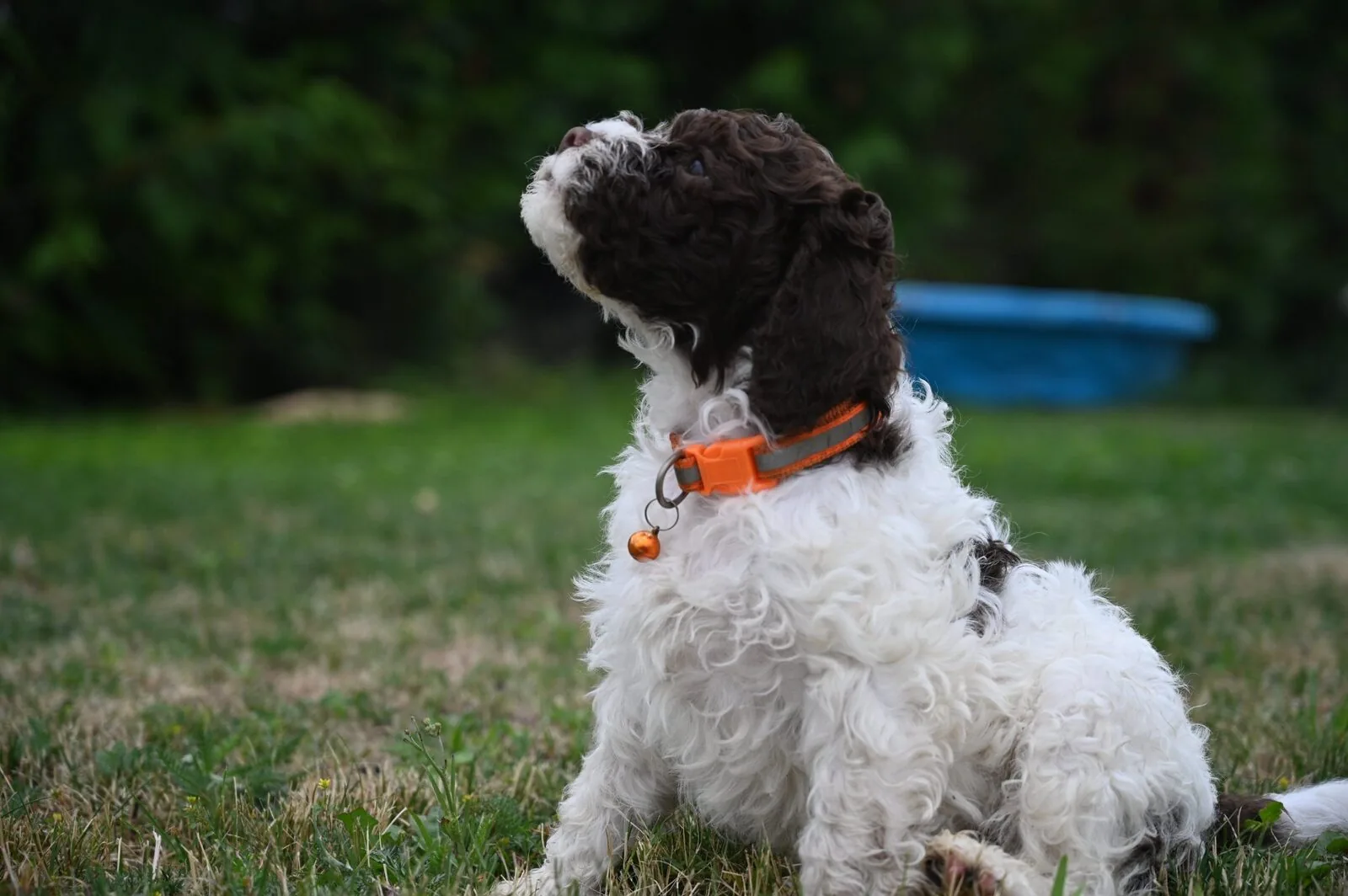
Four feet on the floor. Weight back. Eyes up. This is what manding looks like, and it starts at four weeks.
If you have questions about manding or want to know more about the Puppy Culture protocols we use from day three, get in touch. I am always happy to talk through it.
MarkOne thing I taught differently in the early years. When I first introduced manding to NWL litters, I treated it as a discrete training session, twice a day, three minutes each, away from feeding and play. The puppies learned, but slowly. I now run it as continuous reinforcement throughout the day rather than as scheduled sessions: every interaction with a four- to seven-week-old puppy that involves food, a toy, attention, or movement gets routed through a manding moment. The total time spent on it is similar. The uptake is dramatically faster. This is the kind of small calibration that comes only from doing the same thing repeatedly across many litters and watching what works. The scheduled-session version was not wrong. The continuous-reinforcement version is just better.
We Teach This Before Anything Else
Manding is one of the first things we teach every puppy we produce, not as an add-on, but as a foundation. A dog that has learned to communicate by sitting and looking up is already easier to live with, easier to train, and deeper in relationship with their person than a dog that has not.
Every Northwest Lagotto puppy goes home with manding already in place. We follow up with every family to make sure it is being maintained. If you have questions at any point, at week one, month six, or year five. We are here.
Every Northwest Lagotto Puppy Arrives Knowing How to Mand.
The foundation described in this essay is what your puppy will bring home. If you’d like to see it in practice, or talk about how manding fits into your family’s life. We’re here.
Begin the Conversation →Common Questions
What families ask about manding
What is manding in dog training?
Manding is when a dog sits and makes eye contact to ask for something - attention, a treat, to be picked up, for a door to open. The word comes from B.F. Skinner’s 1957 term ’mand’ for a verbal act initiated by the speaker to get something they want. Unlike a command, a mand originates with the animal. A dog that has learned to mand sits automatically, without being asked, whenever they want something from you - and a dog that always mands to greet never needs to jump.
When do you start teaching a puppy to mand?
At Northwest Lagotto, manding begins at four weeks of age, in short two-to-three minute sessions. At this age puppies are becoming mobile and social. We use a clicker to mark the exact moment the puppy sits and makes eye contact, followed immediately by a small treat. We are not luring the sit - we are waiting for the puppy to offer it. By eight weeks, when the puppy goes home, manding is already in place. The new family’s job is to maintain it.
Why is jumping so hard to fix in older dogs?
Jumping becomes ingrained because it was installed early and rewarded repeatedly. Puppies jump because it worked - you bent down, picked them up, or responded with any form of attention. By adolescence the behavior is deeply learned. Conventional fixes (pushing away, saying ’off’) require the dog to be already jumping before the correction lands, and many reactions still constitute attention. Manding solves this by going before the problem: a puppy taught from four weeks that sitting produces what they want never develops the jumping habit.