At three days old, a puppy cannot see. It cannot hear. It cannot regulate its own body temperature. It can barely crawl. Its brain is a rough draft, millions of neural connections forming, competing, and pruning themselves in a process that will never again be as rapid or as consequential as it is right now.
This is the moment we begin. Not because the puppy is ready for training. It is weeks from anything that would resemble training, but because the brain is ready for shaping. And the window during which it can be shaped this way will not stay open long.
What Puppy Culture Actually Is
Puppy Culture is a comprehensive early development program created by breeder and trainer Jane Killion. It provides breeders with a structured, research-based protocol for the first twelve weeks of a puppy’s life, a protocol that translates decades of developmental neuroscience into specific, timed interventions that shape the puppy’s temperament, resilience, and capacity for learning.
The program is not a checklist. It is not a brand. It is not a label you attach to a litter to justify a higher price. It is a commitment to a specific sequence of exercises, exposures, and interactions that must happen at the right time, in the right order, at the right intensity, because the developing puppy brain is only receptive to certain inputs during certain windows.
Miss the window, and you cannot go back. This is the central fact of early puppy development, and it is the reason Puppy Culture exists.
A puppy raised under Puppy Culture is not just better socialized. It is neurologically different, wired, at the level of the brain, for resilience, confidence, and the capacity to learn from new experience rather than shut down in front of it.
The Science of Critical Windows
The foundational research behind Puppy Culture comes from Scott and Fuller’s landmark 1965 study Genetics and the Social Behavior of the Dog, the most comprehensive study of canine development ever conducted. Over thirteen years and hundreds of dogs across five breeds, Scott and Fuller identified a series of critical developmental periods in which the puppy’s brain is uniquely sensitive to specific types of input.
These are not vague windows. They are biologically determined, breed-consistent, and remarkably precise:
The precision of these windows is what makes Puppy Culture both powerful and demanding. An exercise performed at four weeks produces a fundamentally different neurological outcome than the same exercise performed at twelve weeks. The protocol is not arbitrary. It is timed to the biology.
The Bio Sensor Program
Early Neurological Stimulation was derived from research conducted by the US military’s “Bio Sensor” program, which studied the effects of early stress exposure on working dogs. Dr. Carmen Battaglia’s subsequent work demonstrated that puppies exposed to five specific handling exercises for three to five seconds each, once daily between days 3 and 16, showed measurably improved cardiovascular performance, stronger adrenal systems, greater tolerance to stress, and enhanced resistance to disease, compared to littermates that were not exposed.
The five exercises are deceptively simple: tactile stimulation of the paws, head held erect, head pointed down, supine position, and thermal stimulation. Each lasts three to five seconds. More is not better. Overstimulation during the neonatal period is harmful. The protocol works precisely because it introduces a mild, controlled stressor that is brief enough to activate the developing stress-response system without overwhelming it.
A note on the evidence. The original Bio Sensor research had small cohorts and imperfect controls, and replication studies have produced mixed results. A 2023 study on commercial breeding kennels (Boone et al., 2023, Animals) found the welfare benefits of ENS were not confirmed at population scale, with careful general handling proving as beneficial as the ENS protocol. I will not overstate what has been proven. What I can tell you from eleven years of doing the protocol with every litter is that the exercises are low-risk when done correctly, the gentle daily handling component is well-supported by research independently of the specific ENS exercises, and the broader Puppy Culture program of enrichment, socialization, and structured exposure has the strongest evidence base of any early intervention available to a breeder. We do ENS because the upside is real and the downside is negligible. But the heart of what works is the broader program, not the five thirty-second handling exercises.
Battaglia, C.L. “Periods of Early Development and the Effects of Stimulation and Social Experiences in the Canine.” Journal of Veterinary Behavior, 2009
What We Actually Do: Week by Week
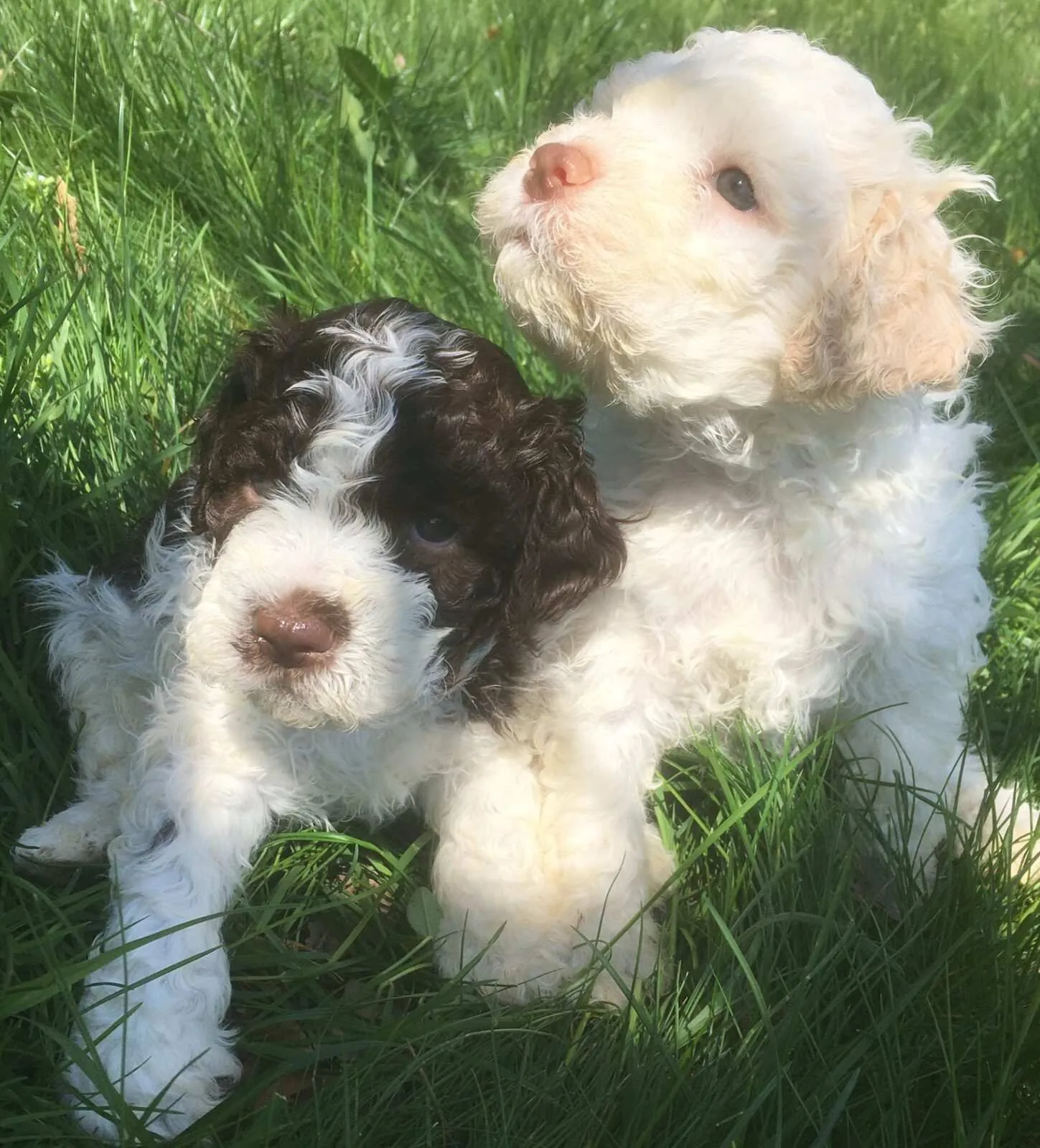
Early weeks. The protocol is already underway.
I want to be specific about what Puppy Culture looks like in practice at Northwest Lagotto, because “we use Puppy Culture” is a claim that many breeders make and few fully execute. The protocol is labour-intensive, time-sensitive, and physically demanding. Here is what it actually involves.
Days 3–16: Every puppy receives ENS handling once per day. Five exercises, three to five seconds each, documented in our whelping log. This happens regardless of litter size, schedule, or convenience. The exercises are never doubled, never extended, and never skipped.
Days 14–21: As eyes and ears open, we introduce novel surfaces beneath the puppies, textured mats, cool tile, soft fleece, crinkled foil. These are not obstacle courses. They are sensory calibration tools, placed in the whelping area so the puppies encounter them in the natural course of exploring their expanding world.
Weeks 3–4: Scent enrichment begins. We introduce novel scent objects, herbs, fabric from different environments, items carried by other animals, into the whelping area. The puppies do not need to “do” anything with them. The olfactory system is activating and the brain is wiring itself to process scent information. We are giving it material to work with.
Manding is introduced at four weeks. This is the formal beginning of communication, the moment the puppy learns that sitting and making eye contact is a language that produces results. The manding essay describes this in full detail.
Weeks 4–5: Startle recovery protocols begin. We introduce unexpected sounds, a dropped pan, a clap, a novel noise, and observe the puppy’s response. The goal is not to prevent the startle. It is to build the recovery. A puppy that startles and recovers quickly has learned something essential: the world sometimes surprises you, and you survive it. A puppy that startles and cannot recover is showing us that more work is needed, gently, gradually, at the puppy’s pace.

Weeks 5–7: The socialization window is fully open. During this period, we expose puppies to people of different ages, genders, and appearances. We introduce them to outdoor surfaces, grass, gravel, wood. We run barrier challenges, small obstacles that require the puppy to problem-solve its way over or around. We begin individual outings away from the litter, so each puppy learns to exist as a single dog, not only as a member of a group.

Week 7–8: Temperament assessment. We observe how each puppy responds to novelty, to challenge, to separation, to handling. These observations inform our placement decisions, which puppy is the best match for which family, based on the specific temperament profile that has emerged over the preceding weeks.
A litter of six puppies raised under the full Puppy Culture protocol represents roughly 400 hours of structured work between birth and placement. It is not something you do casually, and it is not something you can fake.
Want to see the results of this program? Our families describe what their Puppy Culture-raised Lagottos are like to live with.
Read Family Testimonials →What Puppy Culture Does Not Do
I want to be honest about the limits of this protocol, because overselling it would be a disservice to the families who trust us.
Puppy Culture does not produce a finished dog. It produces a dog with the best possible starting point, a nervous system that has been calibrated for resilience, a brain that has been primed for learning, a temperament that has been given every opportunity to develop well. What happens after the puppy goes home matters enormously.
A Puppy Culture puppy that is isolated at home for the first six months will still develop fear issues. A Puppy Culture puppy that is never given boundaries will still develop behavioral problems. A Puppy Culture puppy whose socialization stops at eight weeks will still have gaps.
What Puppy Culture gives you is a foundation, and that foundation is real. A puppy that has been through ENS, startle recovery, barrier challenges, novel surface exposure, individual socialization, and manding arrives in your home with neurological advantages that a puppy raised without these interventions simply does not have. The brain is physically different. The stress-response system is better calibrated. The capacity for learning is demonstrably higher.
But a foundation is not a building. You still have to build on it. And the families who get the most from a Puppy Culture puppy are the ones who understand this, who see the eight weeks of work we did as the beginning, not the end, of a developmental process that extends through the first year and into adolescence.
How to Evaluate a Breeder’s Puppy Culture Claim
Many breeders now claim to use Puppy Culture. Some do. Some use parts of it. Some use the name without the practice. If you are evaluating a breeder’s claim, here is what to look for.
At Northwest Lagotto, we are happy to answer all of these questions. We welcome them. A family that asks hard questions is a family that will do well with a Lagotto.
Why We Do This
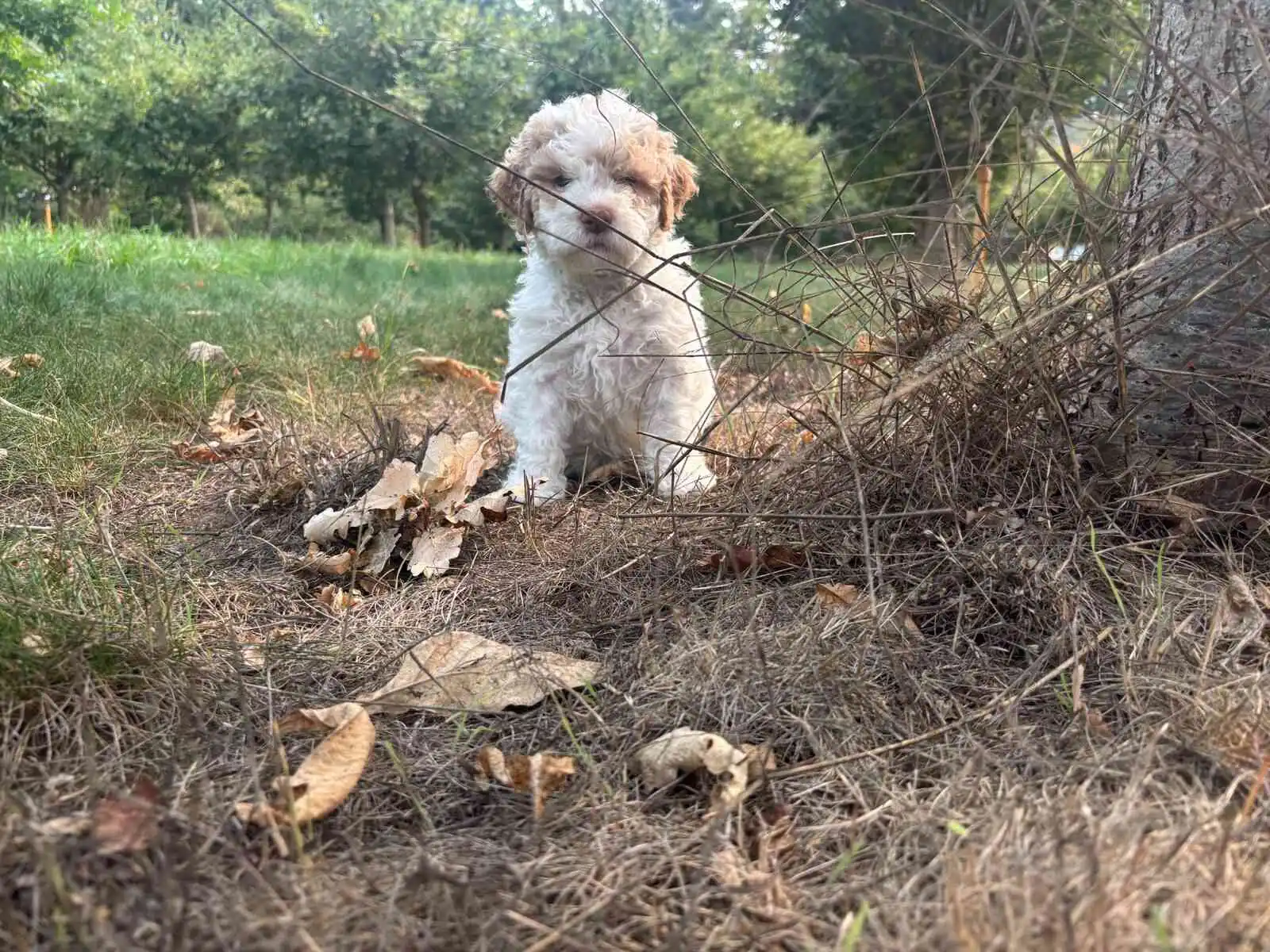
Confident. Curious. Ready for the world. This is what the protocol produces.
Puppy Culture is demanding. It turns the whelping room into a laboratory and the first eight weeks of a litter’s life into an around-the-clock commitment. It means getting up at two in the morning not just to check on puppies, but to conduct a specific developmental exercise that has a specific neurological purpose and must happen on a specific day.
We do it because the science is clear and the results are visible.
A puppy that has been through the full protocol arrives in its new home with a resilience that is not taught. It is built, at the level of the nervous system, during the only period in that dog’s life when such building is possible. That puppy recovers faster from surprises. It learns faster in new environments. It communicates more clearly with the people around it. It handles veterinary visits, grooming, travel, and the general unpredictability of life in a human household with a confidence that did not happen by accident.
We have seen this in every litter we have produced. We hear it from our families months and years later. And it is the reason we will never raise a litter any other way.
The first eight weeks of a dog’s life are the most neurologically consequential period it will ever experience. We treat them accordingly.
The Full Protocol, Every Litter, No Exceptions
Every puppy born at Northwest Lagotto is raised under the complete Puppy Culture program from day three through placement. ENS, startle recovery, barrier challenges, novel surface and sound exposure, manding, individual socialization, and temperament assessment, all documented, all timed to the developmental windows that the science identifies.
We do not offer a reduced version. We do not skip steps in large litters. The protocol is the same whether we are raising four puppies or eight, because the developing brain does not care about our schedule.
Four Hundred Hours of Work Before Your Puppy Comes Home.
That is what Puppy Culture represents in a litter of six. If you want a puppy whose first eight weeks were treated as the most consequential period of its life, because they are. We would welcome the chance to talk.
Ask About Our Next Litter →Common Questions
What families ask about early puppy raising
What is Puppy Culture?
Puppy Culture is a comprehensive early puppy development program created by breeder and trainer Jane Killion. It provides breeders with a structured, research-based protocol for the first twelve weeks of a puppy’s life, covering Early Neurological Stimulation, socialization, enrichment, communication markers, and emotional resilience training.
What is Early Neurological Stimulation (ENS)?
ENS is a series of five brief handling exercises performed on puppies between days 3 and 16 of life. Developed from research by Dr. Carmen Battaglia based on the US military’s Bio Sensor program, ENS has been shown to improve cardiovascular performance, adrenal function, stress tolerance, and immune system resilience in puppies exposed to the protocol.
When does Puppy Culture start?
The formal protocol begins on day three of the puppy’s life with Early Neurological Stimulation. However, the program encompasses the entire first eight to twelve weeks, with different developmental windows requiring different interventions at specific ages.
Does Northwest Lagotto use Puppy Culture?
Yes. Every litter born at Northwest Lagotto is raised under the full Puppy Culture protocol from day three through placement at eight weeks. This includes ENS, startle recovery exercises, barrier challenges, novel surface introduction, sound conditioning, manding, and socialization with people of different ages and appearances.