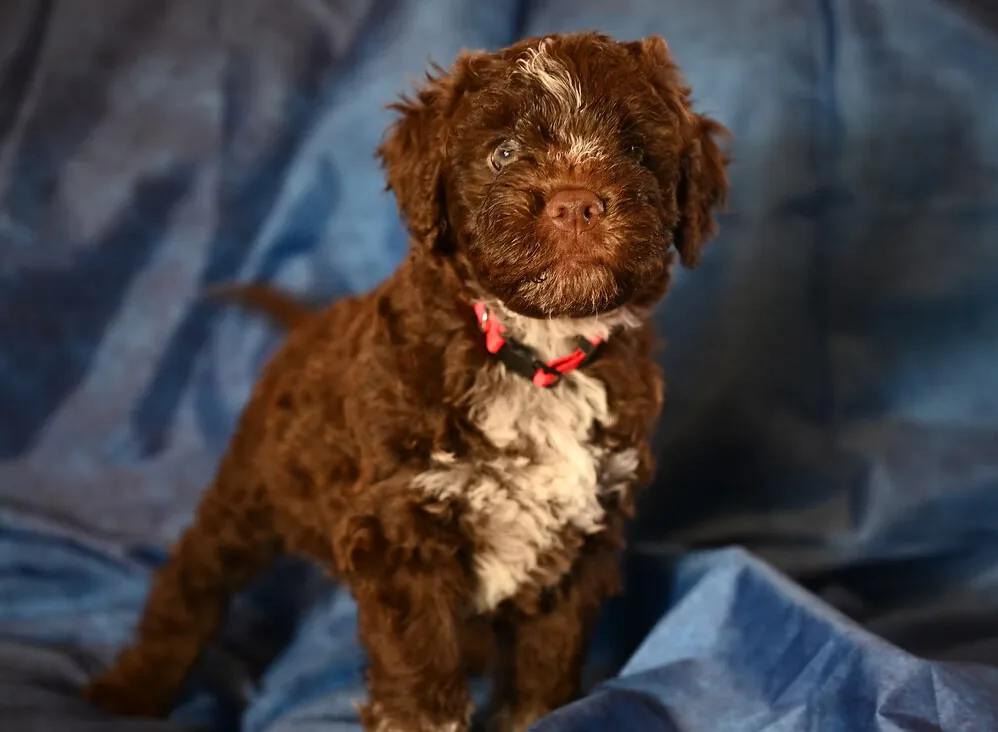
The Breed, Defined
The Lagotto Romagnolo Breed Standard
What the official standards actually say, the Italian original and the American interpretation, point by point and in plain language, by a breeder whose dogs have been judged against them.
A breed standard is the written blueprint a kennel club uses to define a breed, the ideal a judge measures a dog against, and the reference a breeder breeds toward. The Lagotto Romagnolo is described by two principal standards: the Italian original, held by the breed’s country of origin and published internationally as FCI Standard No. 298, and the American Kennel Club standard adopted when the breed entered the AKC Sporting Group in 2015. They agree on nearly everything that matters, a square, rustic, woolly-coated working water dog of medium size, and differ mainly in units of measurement, group classification, and a few points of emphasis. Black is disqualified under both. This guide walks the standard clause by clause, in plain language, with a glossary at the end.
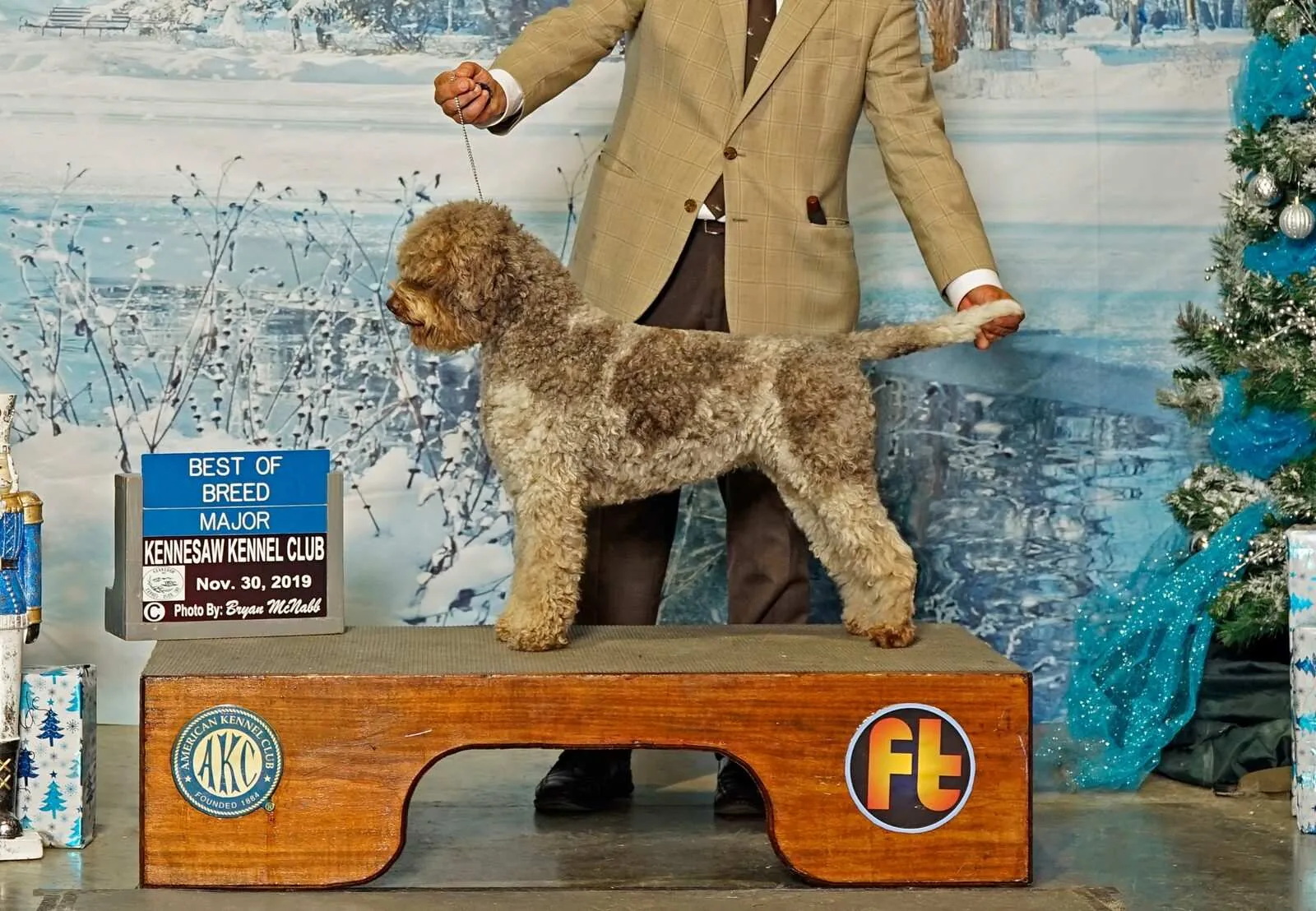
Reading a standard is one thing; being measured against it is another. Our foundation dam, Mocha (IGDM Yelina Salas), a brown roan from Monica Benelli’s Il Granaio dei Malatesta in Bastia Umbra, was campaigned across Italy and Slovenia under FCI judges who spend their careers evaluating this breed. She won CAC and CACIB titles from her opening shows, took Best of Breed repeatedly, and placed third in the Working Group at an all-breed FCI international show in Genova, broadcast on Italian national television. She finished her Italian and Slovenian Championships, then ranked #10 among all Lagotto Romagnolo in the United States in 2020. Every clause below is one our own dogs have been judged on, by people with no stake in the result.
First Principles
What a Breed Standard Is, and Isn’t
A breed standard is a written description of the ideal specimen of a breed: its structure, proportions, head, coat, colour, movement and temperament. Kennel clubs maintain these descriptions so that breeders have a shared target and judges have a shared yardstick. The standard is the reason a Lagotto bred in Lynden and a Lagotto bred in Ravenna are recognisably the same dog.
It helps to be clear about what a standard is for. The Lagotto standard is, at heart, the description of a working dog, a water retriever turned truffle specialist, and almost every clause traces back to function. The waterproof curly coat, the webbed feet, the square and powerful frame, the calm and biddable temperament: these are not cosmetic preferences but the features that let the breed do its job. A good standard preserves function and type. It is not a fashion brief.
And here is the part most prospective owners care about: a standard describes the breeding and show ideal. It does not describe the minimum acceptable pet. A healthy, well-bred Lagotto that happens to stand half an inch too tall, or carries a touch more white than a judge would prefer, is still every bit a Lagotto, and an entirely wonderful companion. We return to that distinction at the end. For what the breed is like to live with, see The Breed; for where it came from, our breed history.
Origin and Authority
Two Standards, One Breed
Under the conventions of international dogdom, a breed’s country of origin holds the master standard. For the Lagotto that is Italy, through the Club Italiano Lagotto and the Italian kennel club, the Ente Nazionale della Cinofilia Italiana (ENCI). That Italian standard, the morphological standard drawn up by Dr Antonio Morsiani after years of biometric measurement, is published worldwide by the Fédération Cynologique Internationale (FCI) as Standard No. 298. It is the version most of the world works from, including the United Kingdom, Canada and Australia.
When the American Kennel Club granted the breed full recognition in 2015, it adopted its own standard, written in the AKC’s house format and placing the Lagotto in the Sporting Group alongside the retrievers and spaniels it is functionally kin to. The FCI instead files the breed in Group 8 (Retrievers, Flushing Dogs and Water Dogs), Section 3, Water Dogs, a more precise nod to its origins. The United Kennel Club recognised the breed in 2006, and the UK’s Royal Kennel Club and the Canadian Kennel Club maintain their own standards, all descended from the same Italian original.
The standards developed alongside the breed’s rescue from near-extinction, a story told in full on our breed history page. The milestones that matter for the standard itself:
So where do the two principal standards actually differ? Less than you might expect. The headline differences:
The two standards are translations of one idea. Where the numbers differ below, it is almost always unit conversion, not disagreement.
General Appearance
A Square, Rustic Dog Built to Work
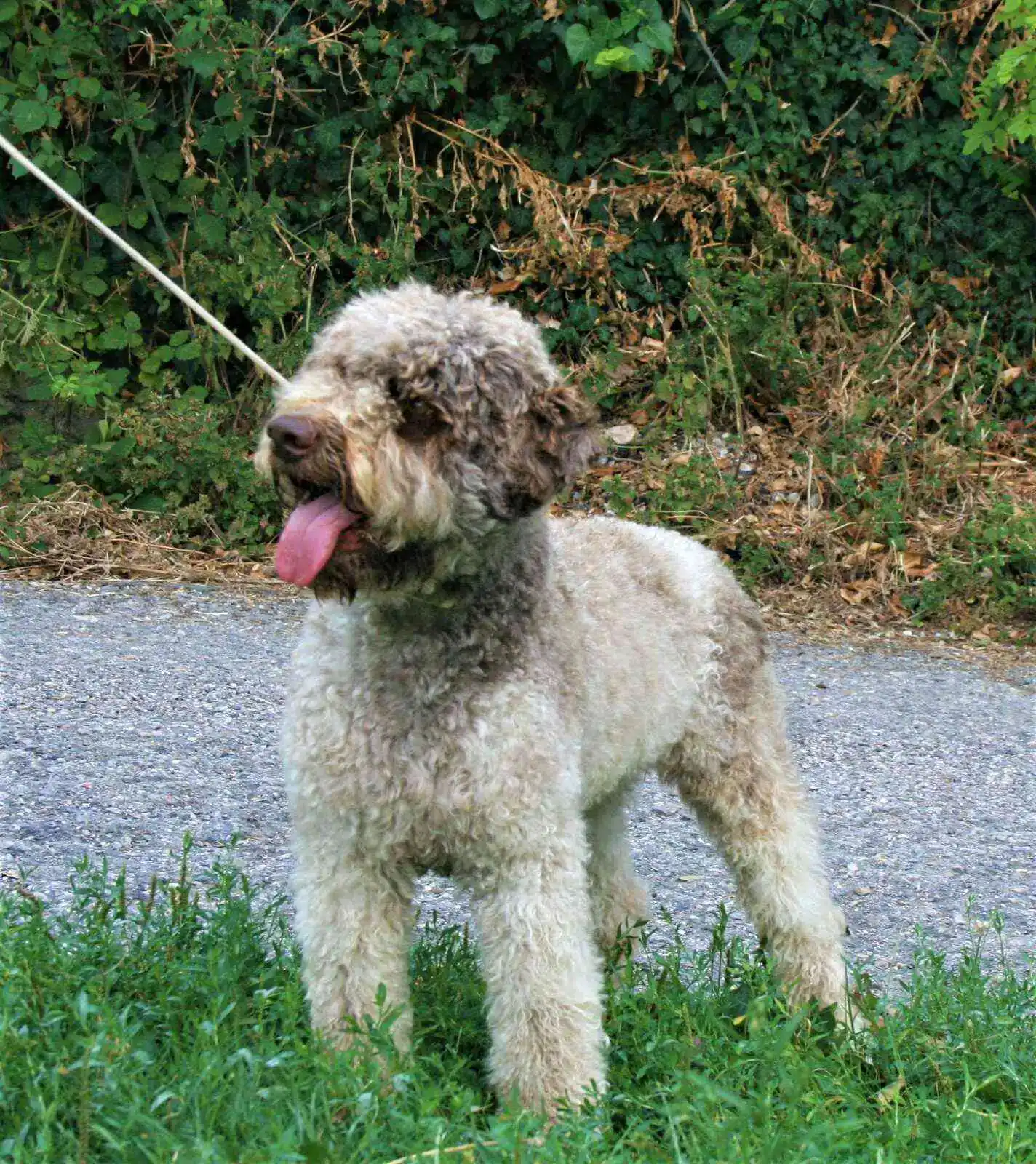
Both standards open in the same place. The Lagotto is a small-to-medium dog, well proportioned and powerfully built, of distinctly rustic appearance, covered in a dense, woolly, curly coat. The impression a correct Lagotto should give is strength and endurance: a dog that looks able to work all day in difficult terrain, in cold water and through thorny woodland.
The defining proportion is that the dog is square: the length of the body, measured from the point of the shoulder (prosternum) to the point of the buttock (ischium), is essentially equal to the height at the withers. The length of the head is four-tenths (40 percent) of the height at the withers, the neck slightly shorter than the head, and the legs a little more than half the height at the shoulder. These are not arbitrary numbers; a square, balanced frame is what gives the breed its efficient, tireless working movement.
It is a deliberately unexaggerated breed. Nothing about the correct Lagotto is extreme: not the bone, not the coat length, not the angulation. The standard rewards a natural, functional, moderate dog over a flashy one, and that restraint is itself part of breed type.
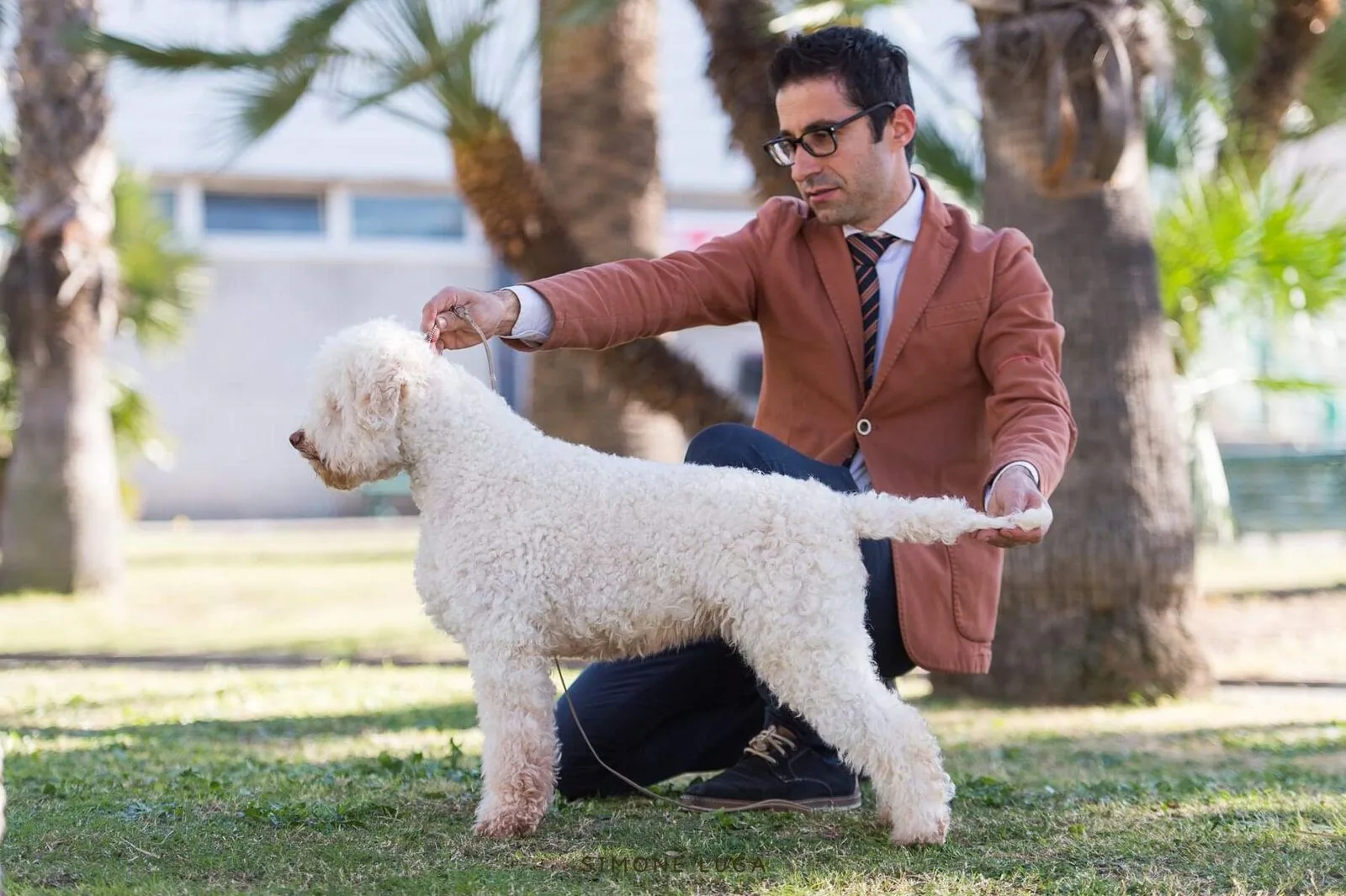
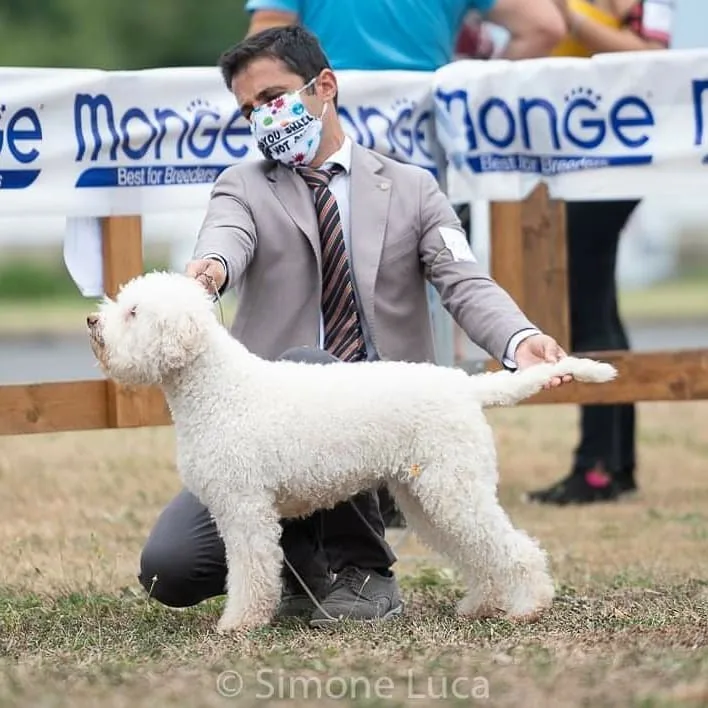
Both photos: IGDM Cannella, from Monica Benelli’s Il Granaio dei Malatesta, the foundation of the Northwest Lagotto programme.
The Head
A Broad, Blunt Wedge and an Honest Expression
Viewed from above and in profile, the head reads as a broad, blunted wedge, trapezoidal and moderately wide at the cheekbones (the zygomatic arches). The skull is slightly longer than the muzzle, broad and slightly convex, with a moderate stop and a marked frontal furrow running up between the eyes. The planes of the skull and muzzle diverge only slightly; converging planes, extreme divergence, or a dished face are all faults.
The nose is large and mobile, with open nostrils and a pronounced central groove, the working end of a scenting breed. Its pigment ranges from light to dark brown according to coat colour, and it must be fully pigmented; depigmentation is a serious fault. The muzzle is fairly deep and tapers only slightly, the lips not too thick, covered by that long bristly moustache.
The eyes are large but never exaggerated, rounded, set fairly well apart, and range from ochre through hazel to dark brown according to coat colour, and only those colours. The expression is alert, keen, intelligent and lively. The ears are medium-sized, triangular with rounded tips, set just above the zygomatic arches, hanging at rest and lifting slightly when the dog is attentive; the hair on them falls in looser, very wavy curls. As for the bite, both standards accept a scissor or level (pincer) bite, and tolerate a slight reverse scissor; an overshot or pronounced undershot bite, one where the incisors no longer touch, is a disqualification.
Neck, Body & Tail
Compact, Strong, and Made for Digging
The neck is strong, muscular and slightly arched, set cleanly into the shoulders, free of dewlap, and a little shorter than the length of the head. The body is compact and square, with a straight back and a short, very strong, slightly arched loin, the standards note the loin’s width equals or exceeds its length, giving the strength a truffle dog needs for digging. The chest is well developed, reaching down to the elbows, though not especially wide. The croup is long, broad and muscular, sloping gently; the AKC pins this at 25 to 30 degrees from the horizontal.
The tail is a point worth knowing. Carried scimitar-like at rest and no higher than the level of the back, it lifts when the dog is alert and may be carried in a loose arc when the dog is working or excited, but it is never curled tightly over the back, and a ring tail is a serious fault. It tapers toward the tip and reaches roughly to the hock. A docked tail or congenital absence of tail is a disqualification under the FCI standard.
One detail betrays the breed’s origins as a water retriever: the feet are slightly rounded and compact, with well-arched toes joined by a connecting membrane: webbed feet, with hard pads and well-pigmented nails. A breed standard is, in this sense, a kind of fossil record; the marshes of the Po Delta are still written into the dog’s feet.
Forequarters & Hindquarters
The Engine Underneath the Coat
Movement is the proof of structure, and structure begins with the limbs. The standards ask for moderate, balanced angulation front and rear, enough to produce a free, efficient stride, never the extreme angles seen in some show breeds. In the forequarters, the shoulder is long and well laid back, the upper arm well angled and muscular, the forelegs straight and vertical when viewed from the front, with strong, slightly sloping pasterns that act as shock absorbers. The elbows sit close to the body.
In the hindquarters, the thighs are long and muscular, the stifle (knee) well bent, and the hocks (the ankle joints) let down low and turning neither in nor out. Seen from behind, the rear legs are straight and parallel. The whole assembly should match the front: a dog over-angulated behind and straight in front, or the reverse, cannot move correctly, however pretty it stands.
On dewclaws, the FCI standard permits their removal, and in practice both standards treat them as a minor point rather than a defining one. The point of this section, invisible under the coat, is the one that matters most over a fifteen-year life: correct angulation is what keeps a working dog’s joints sound.
The Coat, the Heart of the Breed
Woolly, Curled, and Deliberately Rustic
If one feature defines the Lagotto, it is the coat, and the standards treat it with corresponding seriousness, the AKC calls it “extremely important in this breed.” The hair is of woolly texture, semi-rough on the surface, forming tight, ring-shaped curls (not frizz) distributed evenly over the body and tail, with a visible undercoat. Topcoat and undercoat together are waterproof, the entire point in a dog bred to retrieve from cold water. A correct coat is never luxurious, soft or shiny. On the head the curls loosen into those signature eyebrows, whiskers and beard; on the ears they relax into waves.
Two things the coat must never be. It must never be corded, allowed to twist into thin hanging cords. And it must never be sculpted or blown out in the manner of a Poodle or Bichón. Both standards are emphatic: a smooth or straight coat is a disqualification, and excessive styling, scissoring into shape, or fluffing the coat away from its natural curl betrays the breed. Left unclipped, the coat felts as it grows, so a Lagotto must be clipped down at least once a year; the correct trim is short and uniform with the dog’s outline, no more than 4 cm under the FCI standard, 1½ inches under the AKC, and always unpretentious, contributing to the natural, rustic look.
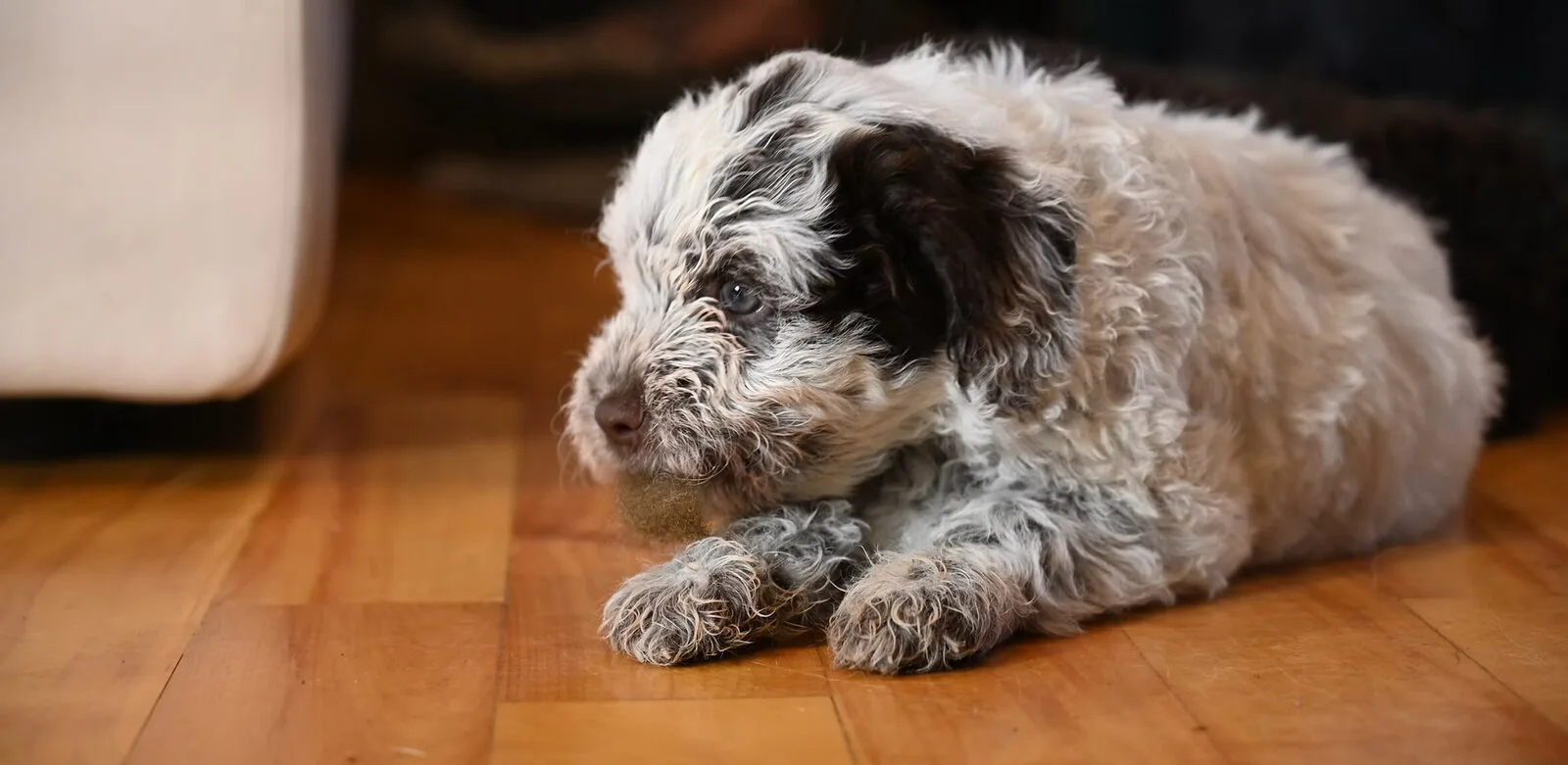
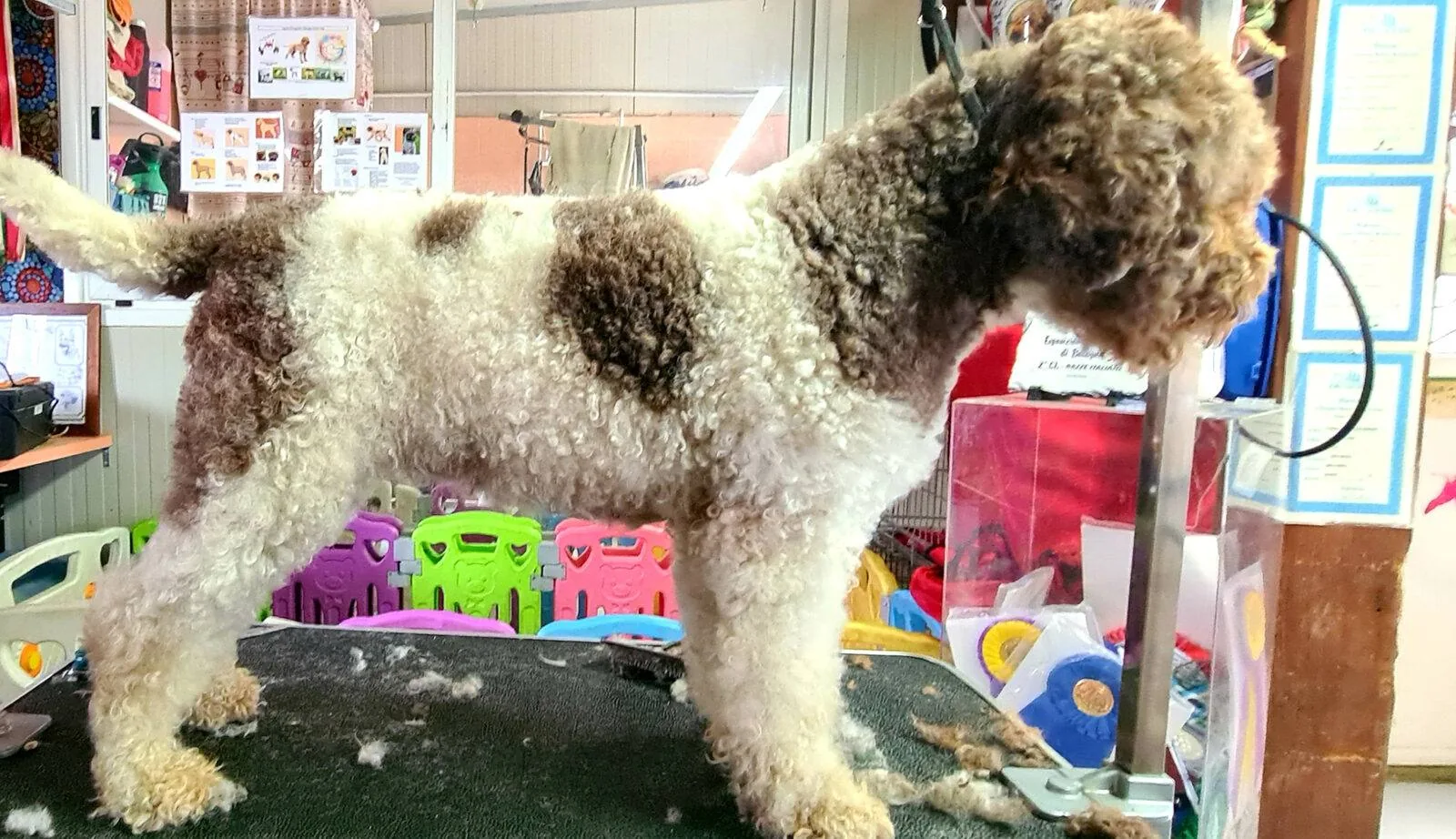
The standard’s “rustic, never sculpted” rule is exactly why Lagotto grooming is its own discipline. We follow the methods of Dutch breeder Katrien van Gemert, the first to win Crufts with a Lagotto and author of Lagotto Romagnolo Grooming: The Art of Keeping It Rustic. The how-to lives in our grooming guide; the coat itself, puppy through adult, in the coat essay.
A word on the question everyone asks: the single-textured, low-shedding curly coat means a Lagotto sheds very little and leaves little loose hair about the house, which many people with mild allergies tolerate well. But no dog is truly hypoallergenic, allergens live in dander and saliva as well as hair. Spend time with the breed before you commit.
Colour
From Off-White to Brown Roan, but Never Black
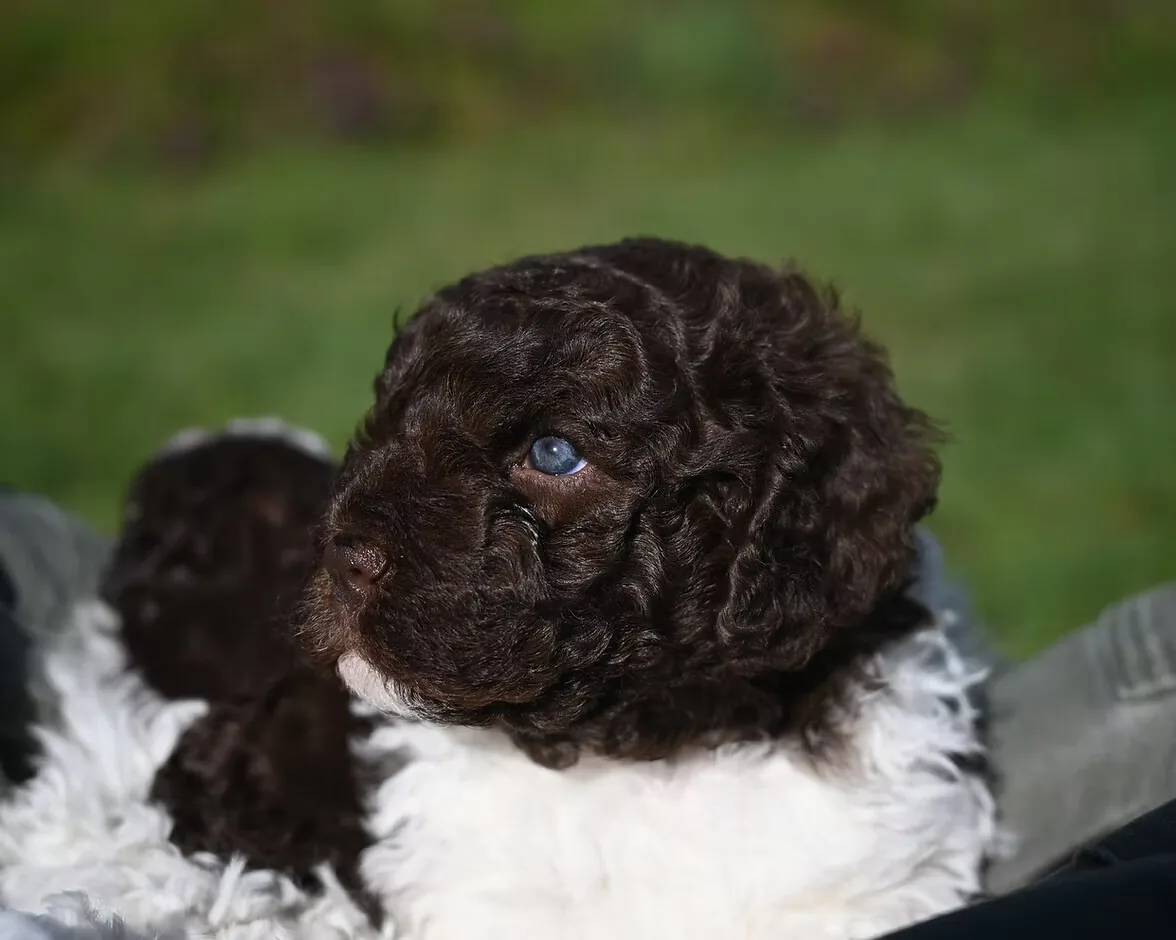
The Lagotto comes in a defined palette, and both standards accept the same family of colours: solid off-white; white with brown or orange patches; brown roan; orange roan; and solid brown or orange, in various shades, with or without white. Tan markings are allowed, and some dogs carry a brown to dark-brown mask. The AKC standard additionally names sable. Both standards also note that the breed’s colours fade with age: a brown can lighten to a silvery or grey roan, and the AKC states plainly that faded and diluted colours are equally desirable. The photographs below are our own dogs and their puppies; you can meet them on Our Dogs.
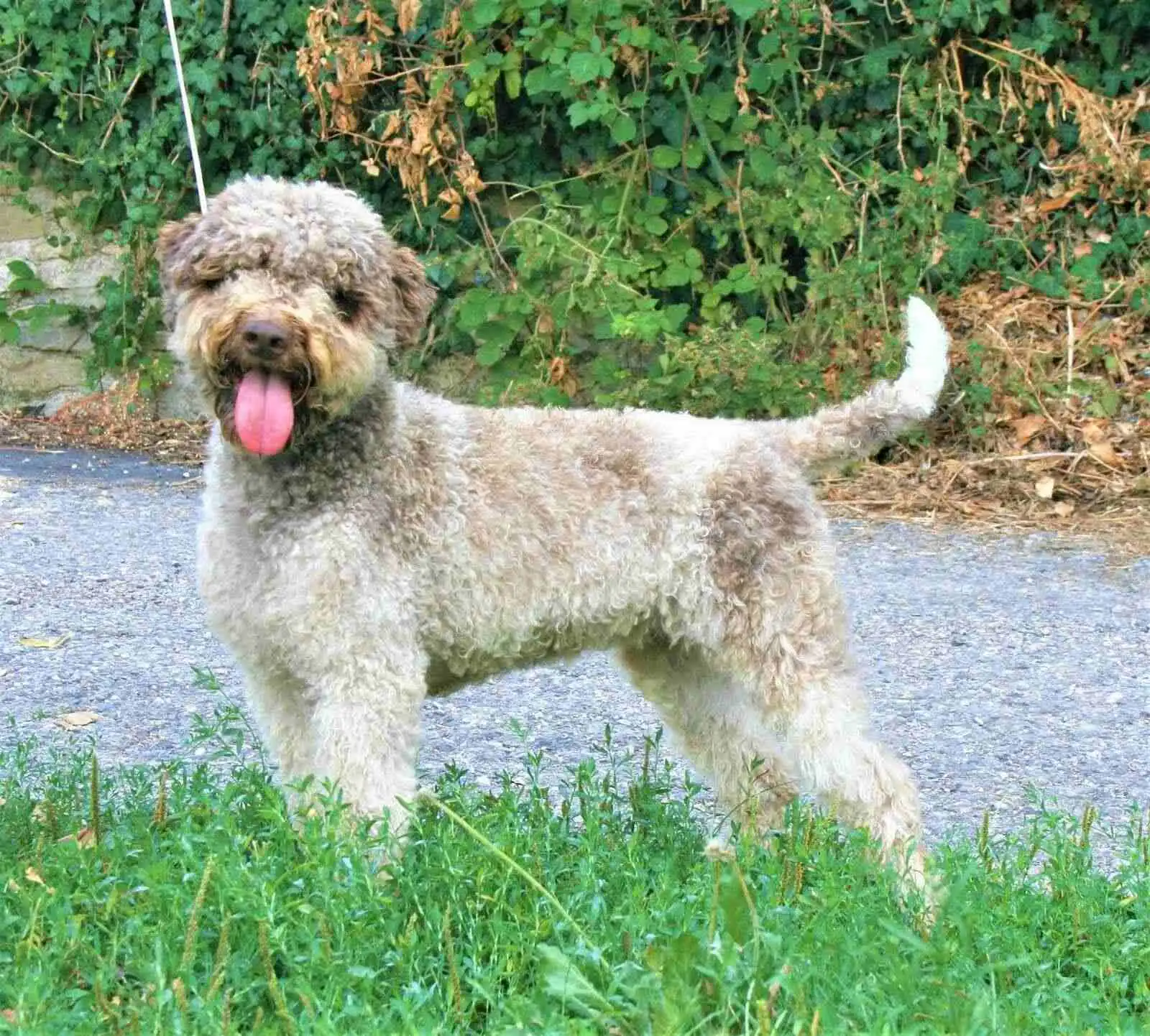
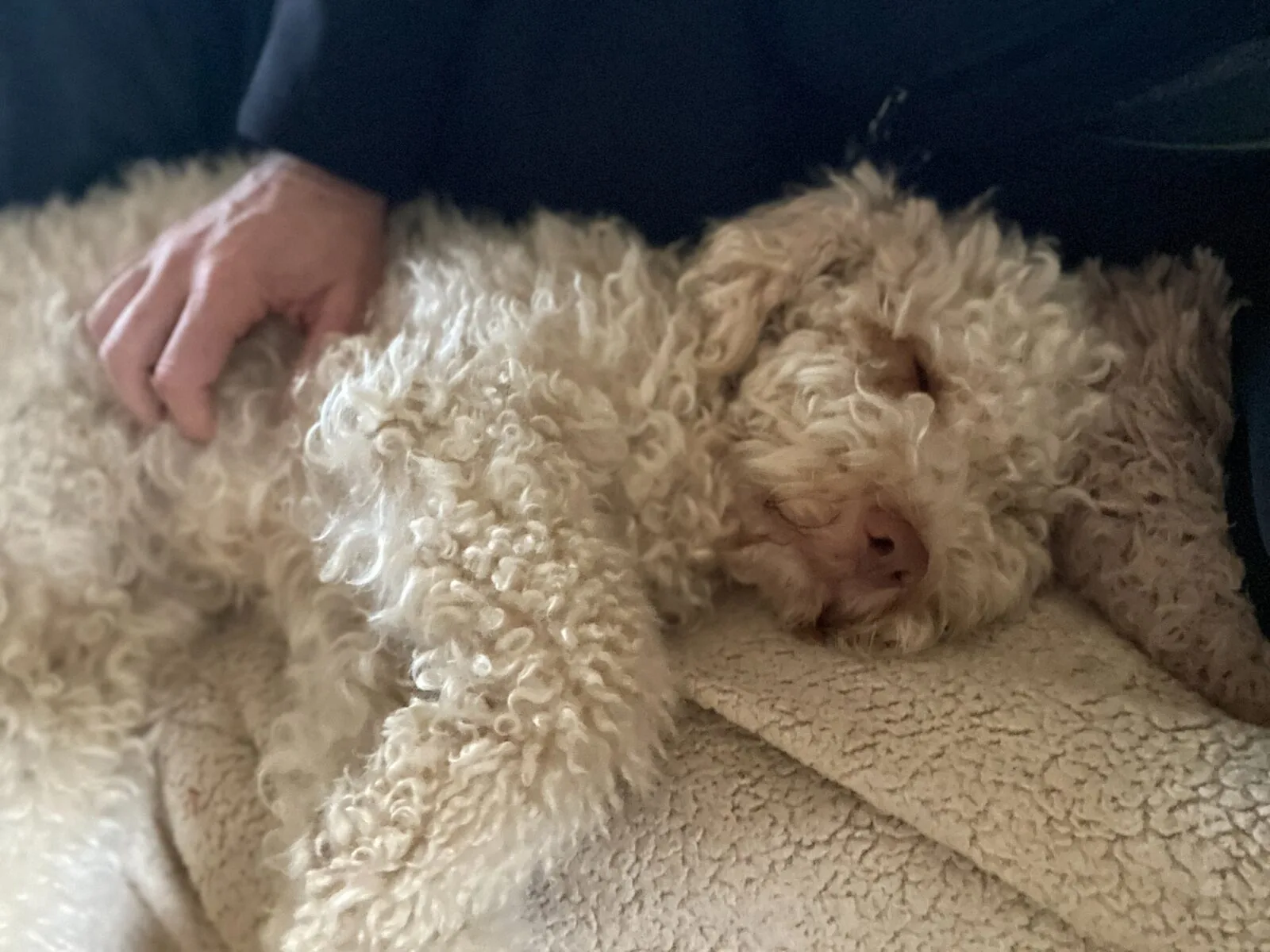
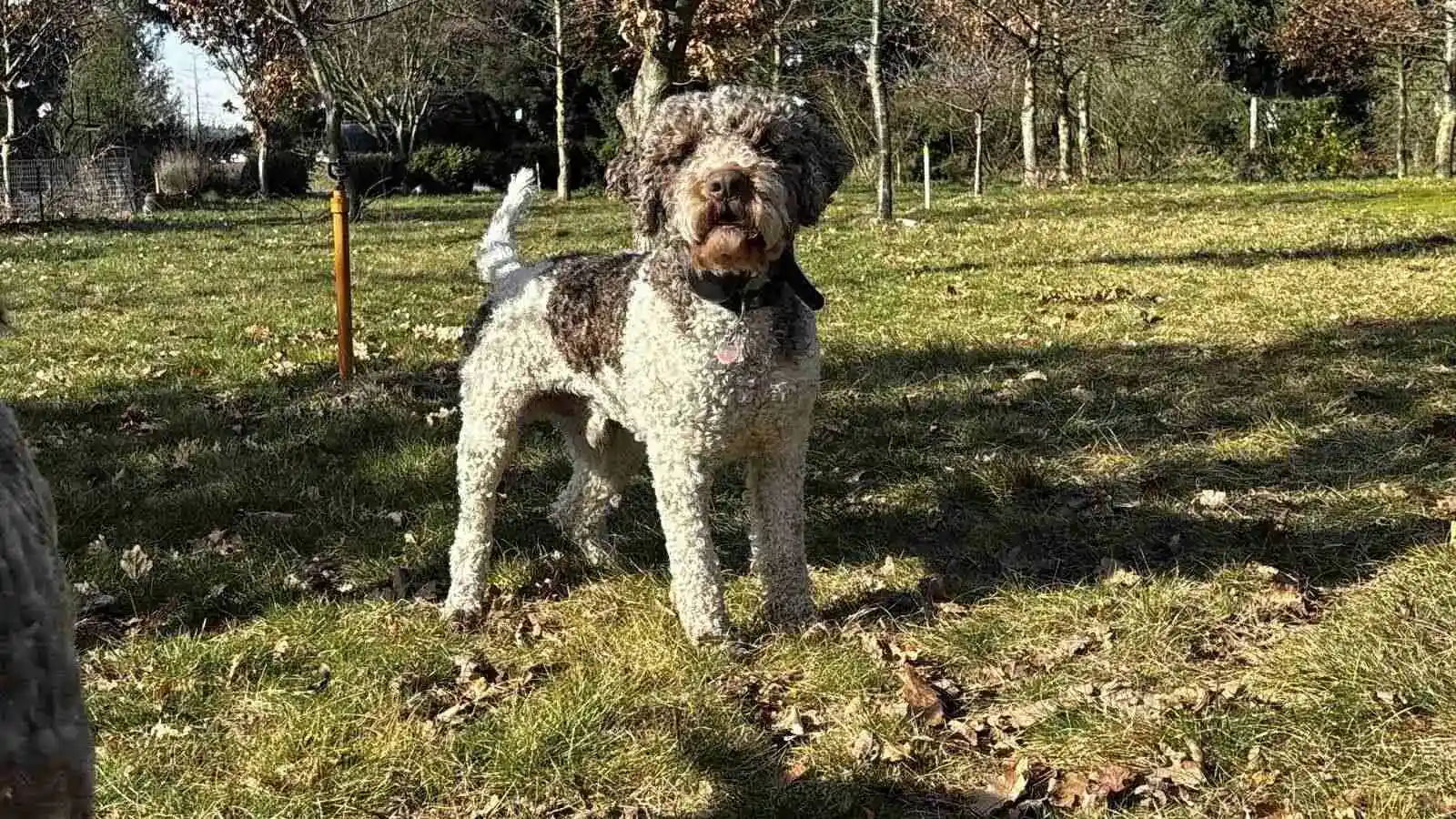
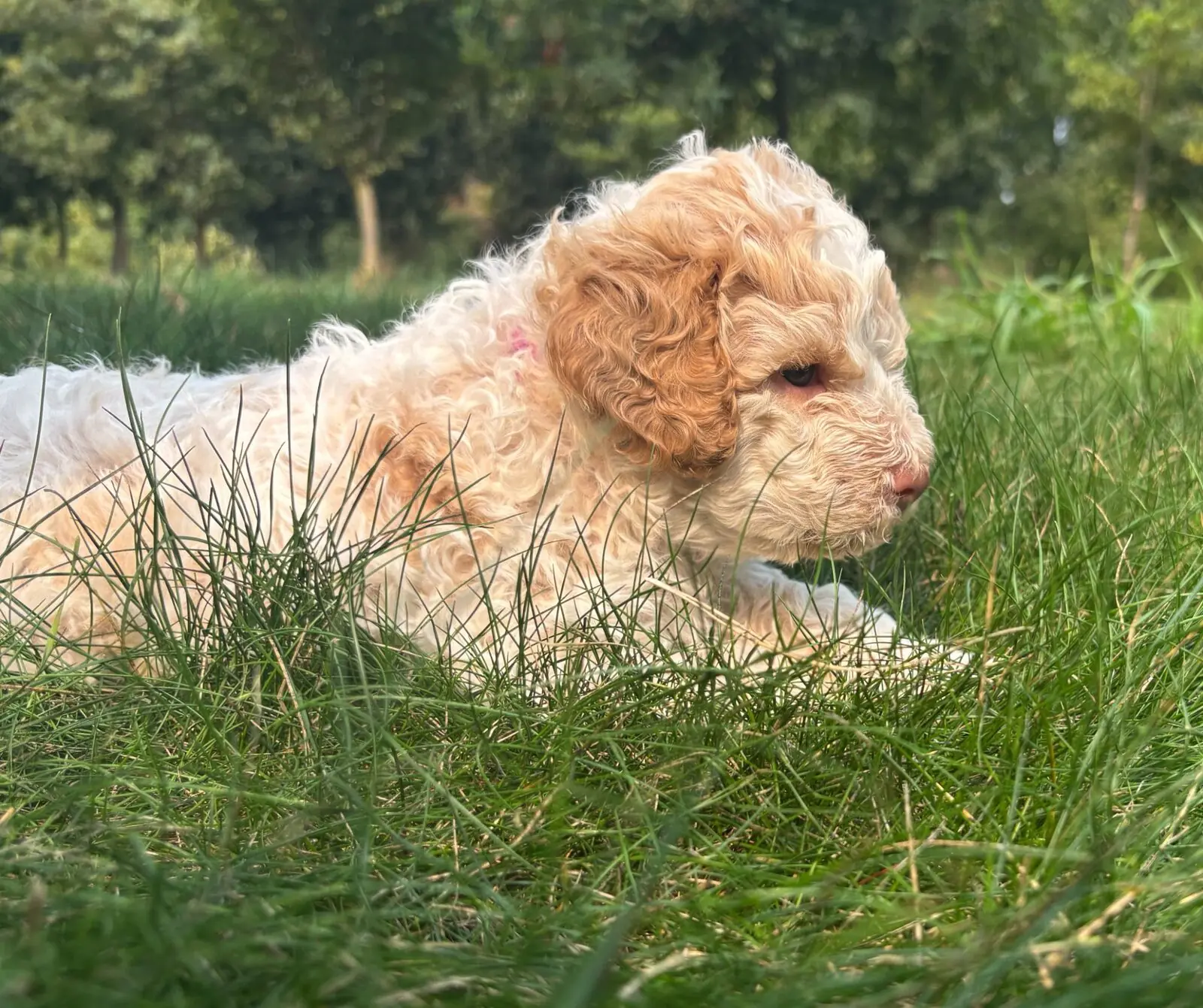
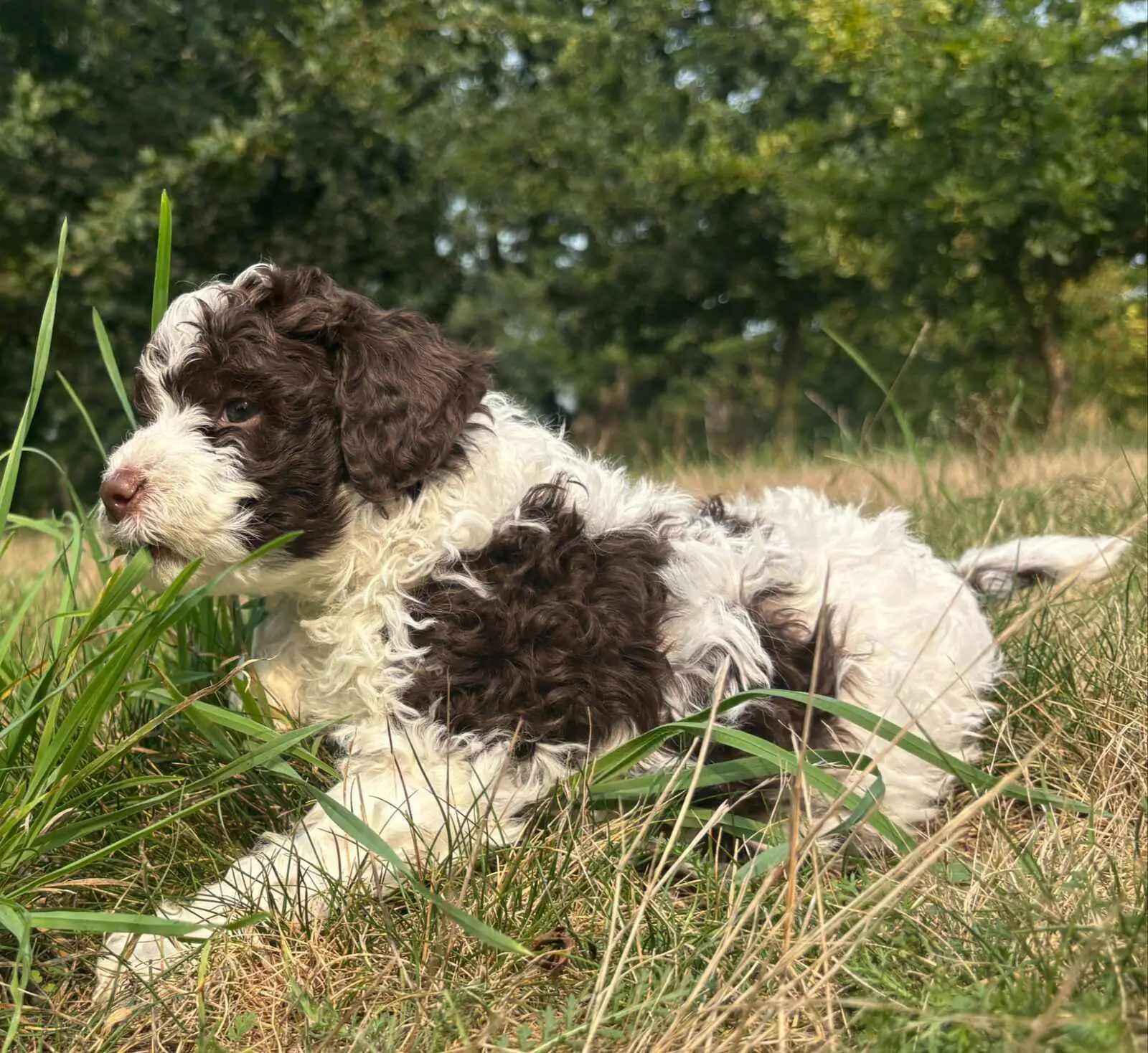
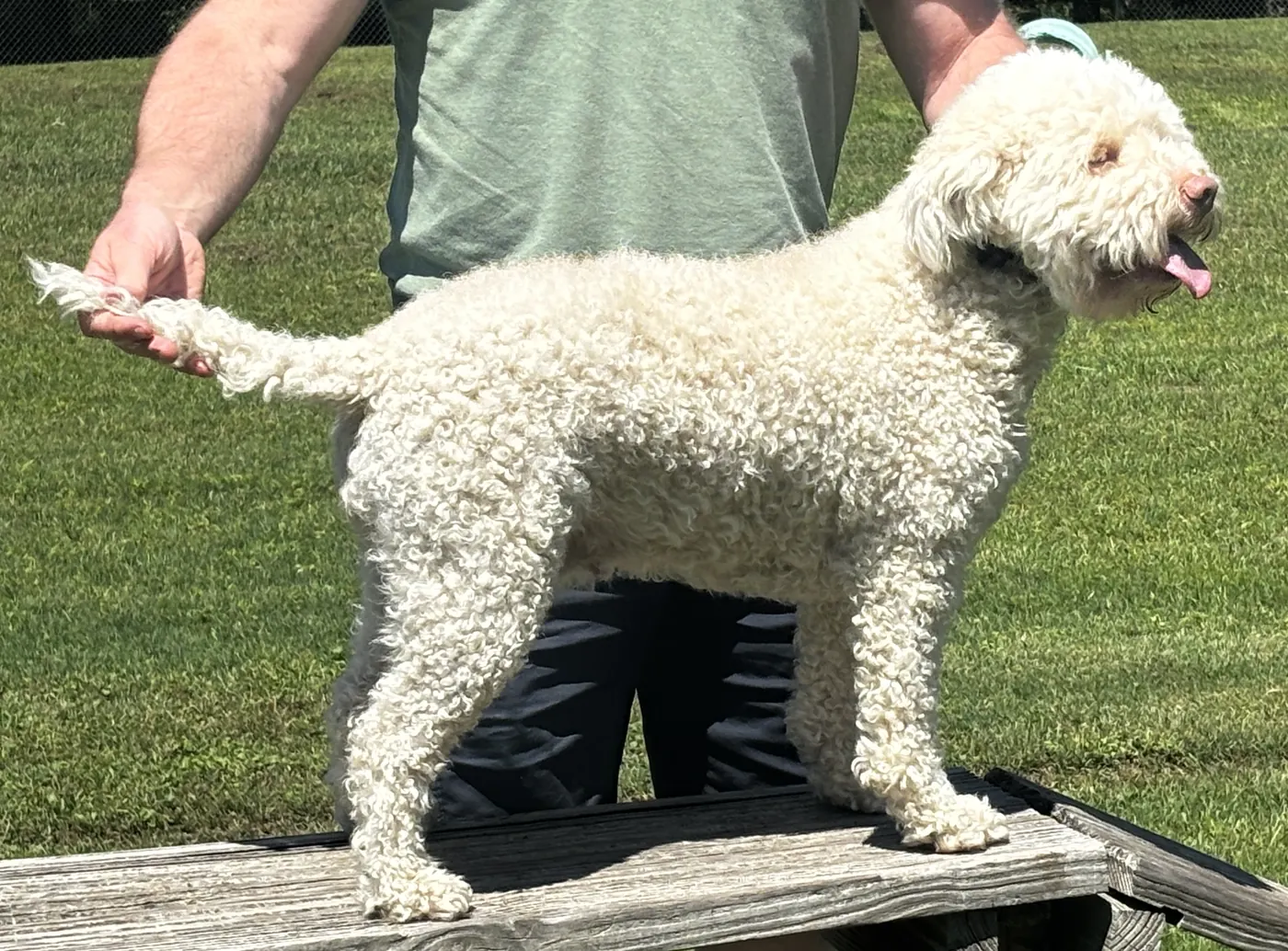
The one hard line both standards draw is black. A black coat, black patches, or black pigment is a disqualification under the FCI and the AKC alike, and the AKC standard adds grey to its disqualification, meaning a genuinely grey or black-shaded coat, not the silvery cast a faded brown roan can take on, which stays entirely correct. This matters for buyers: a “black Lagotto” advertised for sale is, by definition, outside the breed standard, and worth asking hard questions about. For how roan develops, and why a brown puppy can look so different at two years old.
Size & Substance
A Genuinely Medium Dog, No Minis, No Giants
This is the clearest case of two standards saying the same thing in different units. The Lagotto is a true medium-sized breed: substantial enough to be a hardy worker, small enough to live comfortably as a companion.
Note the last row. Both standards disqualify a dog that falls outside the size range, too big or too small. That is the formal answer to a question we are asked constantly: there is no recognised “miniature,” “toy” or “teacup” Lagotto Romagnolo. The breed is defined as a single medium size, and a dog bred or marketed as a mini is being bred away from the standard, not toward it. We say more about that, and about why it matters to a buyer, below.
Gait & Movement
Efficient and Balanced, Never Flashy
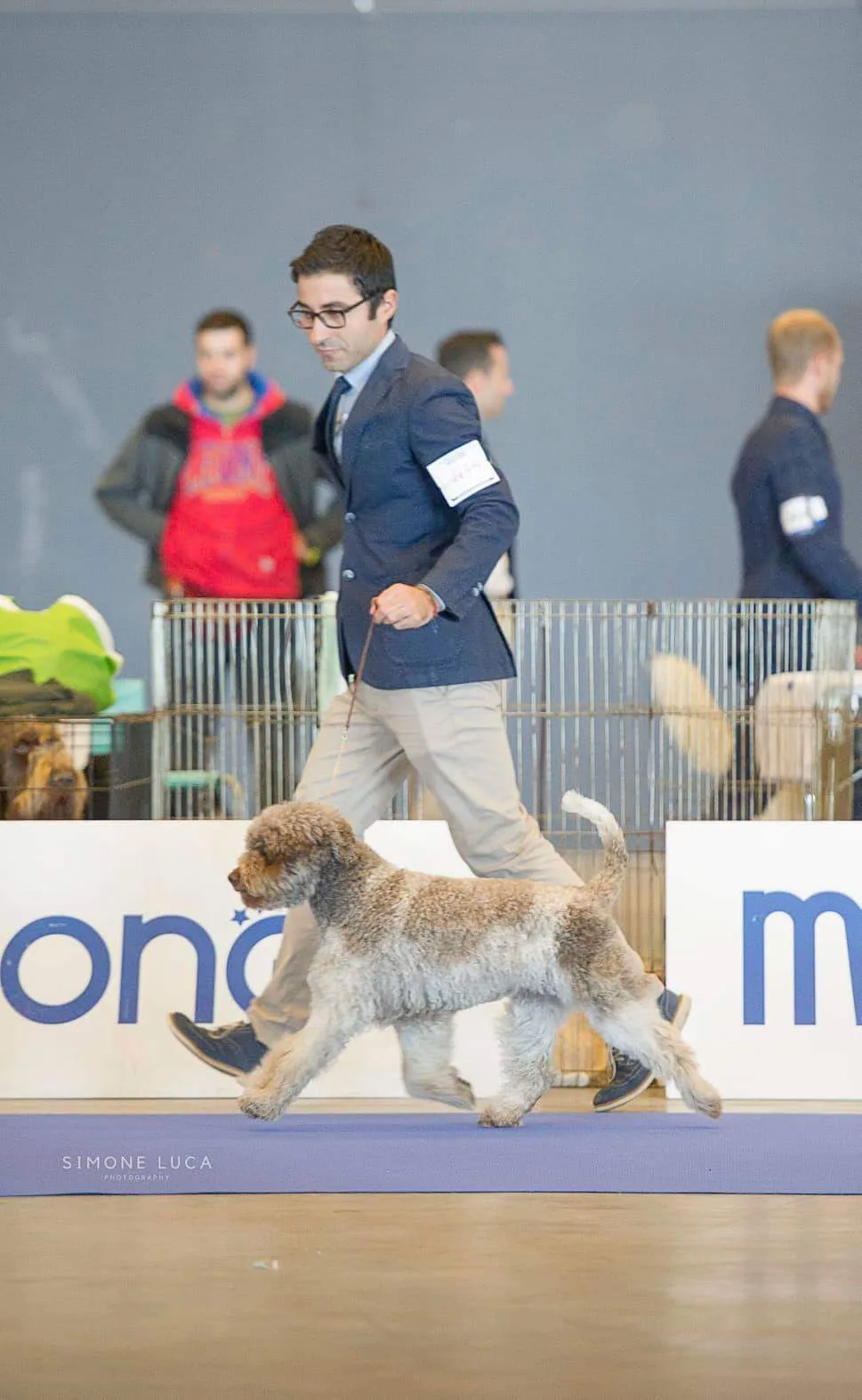
Movement is where structure proves itself. The standards ask for a regular walk and an energetic, brisk, balanced trot with moderate reach and drive, the back staying firm with no tendency to roll, the rear foot covering but not passing the print of the front foot. From the front the legs stay parallel at a walk, converging toward a centre line as speed increases; from behind the hocks stay in a straight line between hip and foot. As the dog quickens, the neck lowers slightly and reaches forward.
The AKC standard adds a pointed instruction: the Lagotto should not be shown in an extended, ground-eating trot. That elongated movement, prized in some sporting breeds, is explicitly called atypical here. It is a small clause that says a great deal about the breed’s character. This is a working dog of quiet competence, and its movement should read the same way: distinction and nobility of bearing, not theatre.
Temperament, the Full Version
Biddable and Devoted, and Genuinely Sensitive
Both standards describe the temperament in warm terms: tractable, undemanding, keen, affectionate and very attached to its owner; highly intelligent and easily trained; an excellent companion and a very good watchdog. The hunting instinct has been modified by generations of selection, so the dog is not distracted by game when it works: a truffle dog must ignore the rabbit to find the fungus. Both are also clear that the breed should never be aggressive or overly shy.
That is the standard’s ideal, and a well-bred Lagotto meets it. But candour about the breed requires one more point that the standards do not make and many breeders gloss over.
A large Finnish study of nearly 14,000 dogs (Salonen et al., 2020, Scientific Reports) found the Lagotto Romagnolo scored relatively high on noise sensitivity and social fearfulness, while showing essentially no compulsive tail-chasing. The breed’s distinctive fear profile is real, well documented, and worth taking seriously before you buy.
None of this is cause to avoid the breed. It is cause to choose the right breeder and do the early work. Sensitivity is not the same as instability: it means the breed responds especially well to confident, gentle handling and especially poorly to harsh methods or a chaotic puppyhood. The protection is structured from birth, early neurological stimulation in the first weeks, deliberate exposure through the developmental windows, and continued socialisation through the fear periods. We raise every litter on the Puppy Culture protocol for exactly this reason, and we cover the science of socialisation and fear periods and of separation in depth. A well-bred, well-socialised Lagotto is a steady, affectionate, deeply bonded companion; the sensitivity is part of what makes the bond so close.
Temperament is heritable, and it is the trait we select for first. The calm, curious quality our foundation dam carried, the quality the families who took her puppies describe in the dogs they live with now, came from somewhere. It came from a kennel that selected for it over decades. A show record tells you a dog’s structure is correct; the temperament behind it is what you actually live with for fifteen years.
Faults & Disqualifications
Where the Standards Draw the Line
Both standards share a sensible philosophy on faults: any departure from the ideal is a fault, and its seriousness is judged in exact proportion to its degree and to how much it affects the dog’s health, welfare and ability to do its traditional work. A disqualification is more severe, a fault grave enough that the dog cannot be awarded in the ring or, by extension, responsibly bred.
The two standards reach the same destination by slightly different routes. The AKC formalises a short list of disqualifications and treats other serious problems as severe faults; the FCI enumerates a longer explicit list. Side by side:
Read across the rows and the agreement is obvious. Both standards protect the same things: stable temperament, correct size and bite, the rustic curly coat, full pigment, eyes of the correct colour, and a tail that never curls over the back.
Reading the Standard as a Buyer
What the Standard Protects You From
You will probably never show your dog. So here is the standard translated into the questions that actually protect a family parting with a deposit. Each of these is a place where the standard is the buyer’s friend.
“Is there a mini, toy or teacup Lagotto?”
No, and the standard is unambiguous. Both the FCI and AKC define one medium size and disqualify dogs that are oversize or undersize. There is no miniature variety, no toy line, no teacup. A breeder advertising a “mini Lagotto” is either crossing the breed with something smaller or selecting runts, in both cases breeding away from the standard and, often, away from health. The right question to a breeder is simple: are both parents within the standard’s size range, and can you show me?
“I found a black Lagotto, or a grey one. Is that rare, or wrong?”
Wrong, in the sense that matters. A black coat is a disqualifying fault under both standards, as is black pigment, and the AKC disqualifies grey as well. Black is simply not a colour this breed comes in. A “rare black Lagotto” is not a prize; it is a sign the dog is either not purebred or bred with no regard for the standard. Do not be confused by the silvery-grey of a faded brown roan, which is correct and common in older dogs. That is fading, not a grey coat.
“How do I tell a dog bred to the standard from one that isn’t?”
You read the dog, and you read the breeder. In the dog: a square, balanced frame; a woolly ring-curled coat kept in a rustic clip, never sculpted or corded; eyes of ochre to dark brown, not blue; a tail that does not curl tightly over the back. In the breeder: parents within the size range, in the accepted colours, with verifiable health testing and ideally some independent confirmation of quality, a show record, a respected pedigree, judges who have evaluated the line. The standard gives you the vocabulary; a good breeder welcomes the questions.
“Does my pet have to be show-quality?”
No, and most are not, including most of ours. A pet-quality puppy is a fully healthy, structurally correct, well-socialised Lagotto that may carry one small cosmetic point (a little over the ideal height, a fleck of mismark) that a judge would notice and a family never will. Show-quality means a dog with no such points, suitable for the ring and the gene pool. Both come from the same litters, the same health testing, the same upbringing. The distinction is about the ring, not about the dog you love.
Conformation Glossary
The Standard’s Vocabulary, Defined
Breed standards are written in a specialised vocabulary. Here are the terms used on this page, in plain language.
For the Prospective Owner
Why the Standard Matters When You’re Choosing a Puppy
You may never set foot in a show ring, and your Lagotto may never be measured against any of this. So why should the standard matter to you? Because it is the single best lens for evaluating a breeder.
A breeder who breeds to the standard is breeding for correct structure, the square frame and balanced angulation that produce sound movement and healthy joints over a fifteen-to-seventeen-year life. They are breeding for the correct coat, the functional, waterproof, low-shedding curls the breed is prized for, not a soft straight coat that mats and disappoints. And they are breeding for the correct temperament, the stable, biddable, devoted dog the standard describes, with the breed’s sensitivity managed rather than amplified. Every one of those matters to a pet owner, even when the dog never competes.
That is the real reason a show record matters to a family looking for a companion. Conformation is structure, and structure is function: a dog built to the standard has joints that move as designed and a coat that behaves as intended. When our foundation dam was judged the finest of her breed in the ring, in Italy, where the breed comes from. That was independent confirmation that the structure we breed from is correct. The puppies inherit the structure and the temperament, whether they ever see a ring or not.
If you want to see the standard expressed in real dogs, including champions judged against exactly these clauses, meet our dogs. If you are weighing breeders, our guide to choosing a breeder and our health and testing page are the practical companions to this one. And when you are ready to talk, the waitlist is where it begins.

More from Northwest Lagotto
Common Questions
What people ask about the Lagotto Romagnolo standard
What is the difference between the FCI and AKC Lagotto standards?
They describe the same dog and agree on type, coat, colour and temperament. The differences are mostly administrative and stylistic. The FCI standard (No. 298, the Italian original) files the breed in Group 8, Water Dogs, and uses metric measurements. The AKC standard places it in the Sporting Group, uses imperial measurements, names sable as an accepted colour, and specifies a 25–30° croup. Both disqualify a black coat.
What colours are accepted, and is a black Lagotto allowed?
Accepted colours are off-white, white with brown or orange patches, brown roan, orange roan, and solid brown or orange with or without white; the AKC also names sable. Tan markings and a brown mask are fine, and faded or diluted colours are equally correct. Black is disqualified under both standards, coat, patches and pigment, and the AKC disqualifies grey as well. A “black Lagotto” for sale is outside the breed standard.
How big does a Lagotto Romagnolo get?
It is a genuinely medium breed. Under the AKC standard, males are 16½–19½ inches at the withers and 28–35 pounds; females 15½–18½ inches and 24–31 pounds. (For a plain-language quick reference, see our size and lifespan guide.) The FCI gives 43–48 cm for males and 41–46 cm for females. Both standards disqualify dogs outside the range.
Is there a miniature or teacup Lagotto Romagnolo?
No. No breed standard recognises a miniature, toy or teacup Lagotto. The standards define one medium size and disqualify dogs that are oversize or undersize. A dog marketed as a “mini Lagotto” is being bred away from the standard.
Can a Lagotto have blue eyes?
Many Lagotto puppies are born with blue eyes that change to the correct ochre, hazel or dark brown as they mature. In an adult, a permanent blue eye or a wall eye (a whitish iris) is a disqualifying fault under both standards. Eye colour should harmonise with the coat.
What coat is correct, and does the Lagotto shed?
The standard calls for a dense, woolly, waterproof coat in tight ring-shaped curls with a visible undercoat, kept in a short rustic clip and never corded or sculpted like a Poodle. The single-textured curly coat sheds very little, one reason the breed appeals to people with mild allergies, but no dog is truly hypoallergenic.
Are Lagotti good family dogs if they’re noise-sensitive?
Yes, for the right family. Research (Salonen et al., 2020) confirms the breed tends toward noise sensitivity and social caution. That is a reason to buy from a breeder who does early neurological stimulation and structured socialisation, and to keep socialising through puppyhood, not a reason to avoid the breed. A well-bred, well-raised Lagotto is a stable, devoted companion.
Does my pet Lagotto have to meet the standard?
No. The standard is the breeder’s blueprint and the judge’s yardstick. A pet-quality puppy is a fully healthy, correct Lagotto that may carry a minor cosmetic point, slightly oversize, a touch of mismark. That would matter in the ring and never in your living room.